
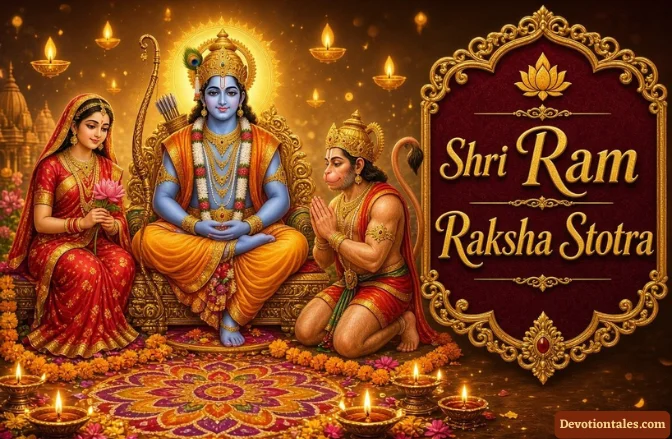
The Shri Ram Raksha Stotra is one of the most sacred and widely revered Sanskrit protective hymns in Hindu tradition. Composed by sage Budhakaushika, this 38-verse stotra is not merely a prayer — it is considered a kavach (divine armour) that wraps the devotee in the protective grace of Lord Shri Ram. Every household in Maharashtra, Gujarat, and across India where Rama worship is central begins the morning with its recitation. If you are searching for the complete Ram Raksha Stotra in Hindi, its meaning in English, or guidance on how to chant it correctly, this article covers everything you need.
Background and History of Ram Raksha Stotra
The Ram Raksha Stotra holds a remarkable origin story embedded within its own verses. According to tradition, the sage Budhakaushika did not compose this stotra through scholarly effort alone. Lord Shiva himself appeared in the sage’s dream and recited all 38 stanzas to him. Upon waking at dawn, Budhakaushika immediately wrote down every verse exactly as he had heard them — a tradition confirmed by verse 15 of the stotra itself.
This divine origin gives the Shri Ram Raksha Stotra a unique status: it carries the combined blessing of both Lord Shiva and Lord Ram. Some scholars identify Budhakaushika with the Vedic sage Vishvamitra, though this connection remains a matter of traditional belief rather than settled textual history.
The stotra is composed in the Anushtup metre (8 syllables per quarter verse), the same metre as vast portions of the Ramayana. Its presiding deity is Shri Sita-Ramachandra, its Shakti is Sita, and its protective pivot — the keelakam — is Hanuman. The name Vajra Panjara (diamond cage), used in verse 14, describes the indestructible armour that sincere recitation builds around the devotee.
Complete Shri Ram Raksha Stotra — Sanskrit Text with Transliteration, English & Hindi Meaning
Viniyoga (Dedicatory Opening)
Sanskrit:
ॐ अस्य श्रीरामरक्षास्तोत्रमन्त्रस्य बुधकौशिक ऋषिः ।
श्रीसीतारामचन्द्रो देवता ।
अनुष्टुप् छन्दः ।
सीता शक्तिः ।
श्रीमद् हनुमान् कीलकम् ।
श्रीरामचन्द्रप्रीत्यर्थे रामरक्षास्तोत्रजपे विनियोगः ॥
English Transliteration: Om Asya Shri Ramaraksha Stotra Mantrasya Budhakaushika Rishih, Shri Sita-Ramachandro Devata, Anushtup Chandah, Sita Shaktih, Shrimad Hanuman Keelakam, Shri Ramachandra Prityarthe Ramaraksha Stotra Jape Viniyogah.
English Meaning: For this Ram Raksha Stotra mantra: the sage is Budhakaushika; the presiding deity is Shri Sita-Ramachandra; the metre is Anushtup; the Shakti is Sita; the protective pivot is Hanuman. This recitation is dedicated to the devotion of Shri Ramachandra.
Hindi Meaning: इस श्री रामरक्षास्तोत्र के ऋषि बुधकौशिक हैं, देवता श्री सीतारामचन्द्र हैं, छन्द अनुष्टुप है, शक्ति सीता हैं और कीलक हनुमान हैं। यह जप श्री रामचन्द्र की प्रसन्नता के लिए है।
Dhyanam (Meditative Verse)
Sanskrit:
ध्यायेदाजानुबाहुं धृतशरधनुषं बद्धपद्मासनस्थं पीतं वासोवसानं नवकमलदलस्पर्धिनेत्रं प्रसन्नम् । वामाङ्कारूढसीतामुखकमलमिलल्लोचनं नीरदाभं नानालङ्कारदीप्तं दधतमुरुजटामण्डलं रामचन्द्रम् ॥
English Transliteration: Dhyayedajanubahum Dhritasharadhanusham Baddhapadmasanastham, Pitam Vasavasanam Navakamalapalaspardhinetram Prasannam, Vamankarudha Sitamukhakamalamilallochanam Niradabham, Nanalankara Deeptam Dadhatamurujatamandalam Ramachandram.
English Meaning: Meditate upon Lord Ramachandra — whose arms extend to his knees, holding bow and arrow, seated in the lotus posture; wearing yellow garments, with eyes that rival fresh lotus petals, with a serene face; Sita seated on his left, his eyes meeting her lotus-like face; his complexion dark as a rain-filled cloud, radiant with many ornaments, bearing a great mass of matted locks.
Hindi Meaning: उन श्री रामचन्द्र का ध्यान करें जिनकी भुजाएँ घुटनों तक लम्बी हैं, जो धनुष-बाण धारण किए पद्मासन में विराजमान हैं; पीताम्बर धारण किए, नवकमल-दल को लजाती आँखों वाले, प्रसन्नमुख; बायीं गोद में सीता जी को बिठाए, वर्षाकाल के मेघ-सा श्यामल रूप, नाना आभूषणों से सुशोभित और विशाल जटामण्डल धारण किए हुए।
Verse 1
Sanskrit:
चरितं रघुनाथस्य शतकोटि प्रविस्तरम् ।
एकैकमक्षरं पुंसां महापातकनाशनम् ॥ १ ॥
English Transliteration: Charitam Raghunathasya Shatakoti Pravistaram, Ekaikamaksharam Punsam Mahapatakanashanam.
English Meaning: The glory of Raghunatha (Lord Ram) is vast — spread across a hundred crore verses. Each single syllable of that divine story destroys the gravest sins of human beings.
Hindi Meaning: रघुनाथ जी का चरित्र सौ करोड़ श्लोकों में विस्तृत है। उस चरित्र का एक-एक अक्षर मनुष्यों के महापातकों को नष्ट करने वाला है।
Verse 2
Sanskrit:
ध्यात्वा नीलोत्पलश्यामं रामं राजीवलोचनम् ।
जानकीलक्ष्मणोपेतं जटामुकुटमण्डितम् ॥ २ ॥
English Transliteration: Dhyatva Nilotpala Shyamam Ramam Rajivalochanam, Janaki Lakshmana Upetam Jatamukuta Manditam.
English Meaning: Meditating upon Ram — dark as the blue lotus, with lotus eyes, accompanied by Janaki (Sita) and Lakshmana, adorned with a crown of matted locks.
Hindi Meaning: नीलकमल जैसे श्यामवर्ण, कमलनयन, जानकी और लक्ष्मण सहित, जटामुकुट से विभूषित श्री राम का ध्यान करते हुए।
Verse 3
Sanskrit:
सासितूणधनुर्बाणपाणिं नक्तञ्चरान्तकम् ।
स्वलीलया जगत्त्रातुमाविर्भूतमजं विभुम् ॥ ३ ॥
English Transliteration: Sasituna Dhanur Bana Panim Naktancharantakam, Svalilaya Jagat Tratum Avirbhutam Ajam Vibhum.
English Meaning: Holding a quiver, bow and arrows in hand, the destroyer of night-wandering demons (rakshasas); the unborn, all-pervading Lord who appeared of his own divine will to protect the worlds.
Hindi Meaning: तरकस, धनुष और बाण हाथ में धारण किए, रात्रि में विचरने वाले दुष्टों का नाश करने वाले; जो अजन्मा और सर्वव्यापी हैं, उन्होंने अपनी लीला से जगत की रक्षा के लिए अवतार लिया।
Verse 4 — Kavach Begins
Sanskrit:
रामरक्षां पठेत्प्राज्ञः पापघ्नीं सर्वकामदाम् ।
शिरो मे राघवः पातु फालं दशरथात्मजः ॥ ४ ॥
English Transliteration: Ramarakshaam Pathetprajnah Papaghnim Sarvakamadaam, Shiro Me Raghavah Patu Phalam Dasharathaja.
English Meaning: Let the wise person recite this Ram Raksha — destroyer of sins and fulfiller of all desires. May Raghava protect my head; may the son of Dasharatha protect my forehead.
Hindi Meaning: बुद्धिमान पुरुष इस पापनाशिनी और सर्वकामदायिनी रामरक्षा का पाठ करे। राघव मेरे सिर की रक्षा करें; दशरथपुत्र मेरे ललाट की रक्षा करें।
Verse 5
Sanskrit:
कौसल्येयो दृशौ पातु विश्वामित्रप्रियः श्रुती ।
घ्राणं पातु मखत्राता मुखं सौमित्रिवत्सलः ॥ ५ ॥
English Transliteration: Kausalyeyo Drishau Patu Vishvamitra Priyah Shruti, Ghranam Patu Makha Trata Mukham Saumitri Vatsalah.
English Meaning: May Kausalya’s son protect my eyes; may the beloved of Vishvamitra protect my ears; may the protector of sacrifices guard my nose; may he who is dear to Lakshmana (son of Sumitra) protect my mouth.
Hindi Meaning: कौसल्या के पुत्र मेरी दोनों आँखों की रक्षा करें; विश्वामित्र के प्रिय मेरे दोनों कानों की रक्षा करें; यज्ञ के रक्षक मेरी नासिका की रक्षा करें; सौमित्रि (लक्ष्मण) को प्रिय मेरे मुख की रक्षा करें।
Verse 6
Sanskrit:
जिह्वां विद्यानिधिः पातु कण्ठं भरतवन्दितः ।
स्कन्धौ दिव्यायुधः पातु भुजौ भग्नेशकार्मुकः ॥ ६ ॥
English Transliteration: Jihvam Vidyanidhi Patu Kantham Bharata Vanditah, Skandhau Divyayudhah Patu Bhujau Bhagnesha Karmukah.
English Meaning: May the treasure of knowledge protect my tongue; may he whom Bharata honours protect my throat; may the wielder of divine weapons protect my shoulders; may he who broke Shiva’s bow protect my arms.
Hindi Meaning: विद्यानिधि मेरी जीभ की रक्षा करें; भरत द्वारा वन्दित मेरे कण्ठ की रक्षा करें; दिव्य आयुध धारण करने वाले मेरे दोनों कन्धों की रक्षा करें; शिव का धनुष तोड़ने वाले मेरी दोनों भुजाओं की रक्षा करें।
Verse 7
Sanskrit:
करौ सीतापतिः पातु हृदयं जामदग्न्यजित् ।
मध्यं पातु खरध्वंसी नाभिं जाम्बवदाश्रयः ॥ ७ ॥
English Transliteration: Karau Sitapatih Patu Hridayam Jamadagnya Jit, Madhyam Patu Khara Dhvamsi Nabhim Jambavad Ashrayah.
English Meaning: May Sita’s husband protect my hands; may the conqueror of Parashurama protect my heart; may the destroyer of Khara protect my waist; may the refuge of Jambavan protect my navel.
Hindi Meaning: सीतापति मेरे हाथों की रक्षा करें; जामदग्न्य (परशुराम) को जीतने वाले मेरे हृदय की रक्षा करें; खर का वध करने वाले मेरे मध्य भाग की रक्षा करें; जाम्बवान के आश्रय (राम) मेरी नाभि की रक्षा करें।
Verse 8
Sanskrit:
सुग्रीवेशः कटिं पातु सक्थिनी हनुमत्प्रभुः ।
ऊरू रघूत्तमः पातु रक्षःकुलविनाशकृत् ॥ ८ ॥
English Transliteration: Sugriveshaha Katim Patu Sakthini Hanumat Prabhuh, Uru Raghuttamah Patu Rakshah Kula Vinashakrit.
English Meaning: May the lord of Sugriva protect my hips; may the master of Hanuman protect my thighs (upper); may the best of Raghus — the destroyer of the demon race — protect my thighs.
Hindi Meaning: सुग्रीव के स्वामी मेरी कमर की रक्षा करें; हनुमान के प्रभु मेरी जंघाओं की रक्षा करें; राक्षस-कुल का नाश करने वाले रघुश्रेष्ठ मेरी ऊरुओं की रक्षा करें।
Verse 9
Sanskrit:
जानुनी सेतुकृत् पातु जङ्घे दशमुखान्तकः ।
पादौ विभीषणश्रीदः पातु रामोऽखिलं वपुः ॥ ९ ॥
English Transliteration: Januni Setukrit Patu Janghe Dashamukha Antakah, Padau Vibhishana Shridah Patu Ramo Akhilam Vapuh.
English Meaning: May the builder of the bridge (Setu) protect my knees; may the slayer of the ten-headed Ravana protect my calves; may he who gave prosperity to Vibhishana protect my feet; may Ram protect my entire body.
Hindi Meaning: सेतु बनाने वाले मेरे घुटनों की रक्षा करें; दशमुख (रावण) का वध करने वाले मेरी पिण्डलियों की रक्षा करें; विभीषण को श्री देने वाले मेरे दोनों पाँवों की रक्षा करें; और श्री राम मेरे समस्त शरीर की रक्षा करें।
Verse 10
Sanskrit:
एतां रामबलोपेतां रक्षां यः सुकृती पठेत् ।
स चिरायुः सुखी पुत्री विजयी विनयी भवेत् ॥ १० ॥
English Transliteration: Etam Ramabalopatam Raksham Yah Sukruti Pathet, Sa Chirayuh Sukhi Putri Vijayi Vinayi Bhavet.
English Meaning: The virtuous person who recites this Ram Raksha, empowered by the strength of Ram, will attain long life, happiness, worthy offspring, victory, and humility.
Hindi Meaning: जो पुण्यात्मा इस रामबलयुक्त रक्षा का पाठ करता है, वह दीर्घायु, सुखी, पुत्रवान, विजयी और विनम्र होता है।
Verse 11
Sanskrit:
पातालभूतलव्योमचारिणश्छद्मचारिणः ।
न द्रष्टुमपि शक्तास्ते रक्षितं रामनामभिः ॥ ११ ॥
English Transliteration: Patala Bhutalavyoma Charinasch Chadmacharinah, Na Drashtumapi Shaktaste Rakshitam Ramanamabhih.
English Meaning: Those who wander secretly in the nether worlds, on earth, and in the sky — even such concealed beings cannot so much as look at one who is protected by the names of Ram.
Hindi Meaning: पाताल, भूमि और आकाश में छल-कपट से विचरने वाले भी उस व्यक्ति को देख तक नहीं सकते जो राम के नामों द्वारा रक्षित है।
Verse 12
Sanskrit:
रामेति रामभद्रेति रामचन्द्रेति वा स्मरन् ।
नरो न लिप्यते पापैर्भुक्तिं मुक्तिं च विन्दति ॥ १२ ॥
English Transliteration: Rameti Ramabhadreti Ramachandreti Va Smaran, Naro Na Lipyate Papair Bhuktim Muktim Cha Vindati.
English Meaning: One who remembers “Rama,” “Ramabhadra,” or “Ramachandra” does not become tainted by sins — and attains both worldly enjoyment (bhukti) and liberation (mukti).
Hindi Meaning: जो व्यक्ति “राम”, “रामभद्र” या “रामचन्द्र” का स्मरण करता है, वह पापों से लिप्त नहीं होता और भोग तथा मोक्ष दोनों को प्राप्त करता है।
Verse 13
Sanskrit:
जगज्जैत्रैकमन्त्रेण रामनाम्नाभिरक्षितम् ।
यः कण्ठे धारयेत्तस्य करस्थाः सर्वसिद्धयः ॥ १३ ॥
English Transliteration: Jagajjaitrai Kamantreena Ramanamna Abhirakshitam, Yah Kanthe Dharayettasya Karasthah Sarvasiddhayah.
English Meaning: One who wears around the neck this Ram Raksha — protected by Ram’s name, the one mantra that conquers all the worlds — has all spiritual accomplishments within reach.
Hindi Meaning: जो व्यक्ति जगत को जीतने वाले एकमात्र मन्त्र — राम-नाम — से सुरक्षित इस रामरक्षा को कण्ठ में धारण करता है, उसके हाथ में सभी सिद्धियाँ रहती हैं।
Verse 14 — Vajra Panjara Verse
Sanskrit:
वज्रपञ्जरनामेदं यो रामकवचं स्मरेत् ।
अव्याहताज्ञः सर्वत्र लभते जयमङ्गलम् ॥ १४ ॥
English Transliteration: Vajrapanjara Namedham Yo Rama Kavacham Smaret, Avyahataajnah Sarvatra Labhate Jayamangalam.
English Meaning: This Ram Kavach is called Vajra Panjara — the diamond cage. Whoever remembers it will have his commands obeyed everywhere and will attain victory and auspiciousness in all things.
Hindi Meaning: इस रामकवच का नाम वज्रपञ्जर है। जो इसे स्मरण करता है, उसकी आज्ञा सर्वत्र मानी जाती है और उसे सर्वत्र जय तथा मंगल प्राप्त होता है।
Verse 15 — The Dream-Revelation Verse
Sanskrit:
आदिष्टवान् यथा स्वप्ने रामरक्षामिमां हरः ।
तथा लिखितवान् प्रातः प्रबुद्धो बुधकौशिकः ॥ १५ ॥
English Transliteration: Adishtavan Yatha Swapne Ramaraksha Imam Harah, Tatha Likhitavan Pratah Prabuddho Budhakaushikah.
English Meaning: Just as Lord Shiva (Hara) commanded and recited this Ram Raksha in a dream, so did the awakened Budhakaushika write it down exactly at dawn.
Hindi Meaning: जैसे स्वप्न में भगवान शिव (हर) ने इस रामरक्षा का आदेश दिया और सुनाया, वैसे ही प्रातःकाल जागकर बुधकौशिक ने उसे ठीक वैसा ही लिख दिया।
Verse 16
Sanskrit:
आरामः कल्पवृक्षाणां विरामः सकलापदाम् ।
अभिरामस्त्रिलोकानां रामः श्रीमान् स नः प्रभुः ॥ १६ ॥
English Transliteration: Aramah Kalpavrikshanam Viramah Sakalapadam, Abhiramas Trilokaanam Ramah Shrimaanasa Nah Prabhuh.
English Meaning: Ram is the garden of wish-fulfilling trees, the end of all calamities, and the delight of all three worlds — that glorious Ram is our Lord.
Hindi Meaning: राम कल्पवृक्षों के उद्यान हैं, समस्त आपदाओं का विराम हैं, तीनों लोकों के आनन्द हैं — वे श्रीमान राम हमारे प्रभु हैं।
Verses 17–19 — Description of Ram and Lakshmana
Sanskrit:
तरुणौ रूपसम्पन्नौ सुकुमारौ महाबलौ ।
पुण्डरीकविशालाक्षौ चीरकृष्णाजिनाम्बरौ ॥ १७ ॥
फलमूलाशिनौ दान्तौ तापसौ ब्रह्मचारिणौ ।
पुत्रौ दशरथस्यैतौ भ्रातरौ रामलक्ष्मणौ ॥ १८ ॥
शरण्यौ सर्वसत्त्वानां श्रेष्ठौ सर्वधनुष्मताम् । र
क्षःकुलनिहन्तारौ त्रायेतां नो रघूत्तमौ ॥ १९ ॥
English Transliteration: Tarunau Rupasamapannau Sukumarau Mahabalau, Pundarika Vishalaakshau Chira Krishnajina Ambarau. (17) Phala Mula Ashinau Dantau Tapasau Brahmacharinau, Putrau Dasharathasyaitau Bhratarou Rama Lakshmanaou. (18) Sharanyau Sarva Sattvanam Shreshthau Sarva Dhanushmatam, Rakshah Kula Nihantarau Trayetam No Raghuttamau. (19)
English Meaning: Young, richly handsome, tender yet mighty; with lotus-wide eyes, wearing bark and black deerskin (17); living on fruits and roots, self-restrained, forest ascetics, celibate; these sons of Dasharatha, the brothers Ram and Lakshmana (18); refuge of all beings, supreme among all bow-bearers, destroyers of the demon race — may these two best of the Raghus protect us (19).
Hindi Meaning: युवा, रूपसम्पन्न, कोमल, महाबली; कमल जैसी विशाल आँखों वाले, वल्कल और कृष्णाजिन धारण किए हुए (17); फल-मूल खाने वाले, जितेन्द्रिय, तपस्वी, ब्रह्मचारी; दशरथ के ये दो पुत्र भाई राम-लक्ष्मण हैं (18); सभी प्राणियों के शरण, सभी धनुर्धरों में श्रेष्ठ, राक्षस-कुल का नाश करने वाले — वे रघुश्रेष्ठ हम दोनों की रक्षा करें (19)।
Verse 20
Sanskrit:
आत्तसज्यधनुषाविषुस्पृषावक्षयाशुगनिषङ्गसङ्गिनौ ।
रक्षणाय मम रामलक्ष्मणावग्रतः पथि सदैव गच्छताम् ॥ २० ॥
English Transliteration: Attasajya Dhanushavishusprishav Akshayashuga Nishanga Sanginau, Rakshanaya Mama Ramalakshmanaav Agratah Pathi Sadaiva Gachchhatam.
English Meaning: May Ram and Lakshmana — their bows strung and drawn, their quivers filled with inexhaustible arrows — always walk ahead of me on the path, for my protection.
Hindi Meaning: चढ़े हुए धनुष, बाण को स्पर्श किए, अक्षय तरकस धारण किए हुए राम और लक्ष्मण मेरी रक्षा के लिए सदा मेरे मार्ग में आगे-आगे चलें।
Verse 21
Sanskrit:
सन्नद्धः कवची खड्गी चापबाणधरो युवा ।
गच्छन् मनोरथान्नश्च रामः पातु स लक्ष्मणः ॥ २१ ॥
English Transliteration: Sannaddhah Kavachi Khadgi Chapa Bana Dharo Yuva, Gachchhan Manorathannashcha Ramah Patu Sa Lakshmana.
English Meaning: Young, armoured, bearing sword, bow and arrow — may Ram and Lakshmana, moving ahead, protect us and fulfil all our desires.
Hindi Meaning: सज्जित, कवचधारी, खड्ग और चाप-बाण से युक्त, युवा — आगे बढ़ते हुए राम और लक्ष्मण हमारी रक्षा करें और हमारी मनोकामनाएँ पूर्ण करें।
Verses 22–23
Sanskrit:
रामो दाशरथिः शूरो लक्ष्मणानुचरो बली ।
काकुत्स्थः पुरुषः पूर्णः कौसल्येयो रघूत्तमः ॥ २२ ॥
वेदान्तवेद्यो यज्ञेशः पुराणपुरुषोत्तमः ।
जानकीवल्लभः श्रीमानप्रमेयपराक्रमः ॥ २३ ॥
English Transliteration: Ramo Dasharathih Shuro Lakshmananucharo Bali, Kakutsthah Purushah Purnah Kausalyeyo Raghuttamah. (22) Vedantavedyo Yajneshah Purana Purushottamah, Janakivalabhah Shrimaanprameyaparakramah. (23)
English Meaning: Ram, son of Dasharatha, the heroic, with Lakshmana in attendance, mighty; of the Kakutstha lineage, the perfect being, Kausalya’s son, best of Raghus (22); known through Vedanta, lord of sacrifices, the eternal Purushottama; the beloved of Janaki, glorious, of immeasurable valour (23).
Hindi Meaning: दशरथपुत्र राम, वीर, लक्ष्मण सहित, बलशाली; काकुत्स्थ कुल में उत्पन्न, पूर्ण पुरुष, कौसल्यापुत्र, रघुवंश में श्रेष्ठ (22); वेदान्त द्वारा जाने जाने वाले, यज्ञ के ईश्वर, पुराण-प्रसिद्ध पुरुषोत्तम; जानकी के प्रिय, श्रीमान, अप्रमेय पराक्रम वाले (23)।
Verse 24
Sanskrit:
इत्येतानि जपेन्नित्यं मद्भक्तः श्रद्धयान्वितः ।
अश्वमेधाधिकं पुण्यं सम्प्राप्नोति न संशयः ॥ २४ ॥
English Transliteration: Ityetani Japennityam Madbhaktah Shraddhayanvitah, Ashvamedhadhikam Punyam Samprapnoti Na Samshayah.
English Meaning: My devotee who recites these names daily with sincere faith obtains merit exceeding that of the Ashvamedha (horse sacrifice) — there is no doubt about this.
Hindi Meaning: जो मेरा भक्त श्रद्धा सहित इन नामों का नित्य जप करता है, वह अश्वमेध यज्ञ से भी अधिक पुण्य प्राप्त करता है — इसमें कोई सन्देह नहीं।
Verse 25
Sanskrit:
रामं दूर्वादलश्यामं पद्माक्षं पीतवाससम् ।
स्तुवन्ति नामभिर्दिव्यैर्न ते संसारिणो नराः ॥ २५ ॥
English Transliteration: Ramam Durvadala Shyamam Padmaksham Pitavasasam, Stuvanti Namabhir Divyair Na Te Samsarino Narah.
English Meaning: Those who praise Lord Ram — dark as the blade of dūrvā grass, with lotus eyes, dressed in yellow raiment — with his divine names, such devotees are no longer bound to the cycle of worldly existence.
Hindi Meaning: जो लोग दूर्वा के पत्ते जैसे श्यामवर्ण, कमलनयन और पीताम्बरधारी श्री राम की दिव्य नामों से स्तुति करते हैं, वे संसार के बन्धन से मुक्त हो जाते हैं।
Verse 26
Sanskrit:
रामं लक्ष्मणपूर्वजं रघुवरं सीतापतिं सुन्दरम् काकुत्स्थं करुणार्णवं गुणनिधिं विप्रप्रियं धार्मिकम् ।
राजेन्द्रं सत्यसन्धं दशरथतनयं श्यामलं शान्तमूर्तिम् वन्दे लोकाभिरामं रघुकुलतिलकं राघवं रावणारिम् ॥ २६ ॥
English Transliteration: Ramam Lakshmana Purvajam Raghu Varam Sita Patim Sundaram, Kakutstham Karunarnavam Gunanidham Viprapriyam Dharmikam, Rajendram Satyasandham Dasharatha Tanayam Shyamalam Shantamurtim, Vande Lokabhiramam Raghukula Tilakam Raghavam Ravanaarim.
English Meaning: I bow to Lord Ram — elder brother of Lakshmana, best of Raghus, husband of Sita, the beautiful; of the Kakutstha lineage, an ocean of compassion, treasury of virtues, dear to the learned, ever righteous; king of kings, true to his word, son of Dasharatha, dark-complexioned, embodiment of peace; the delight of all worlds, crown jewel of the Raghu clan, enemy of Ravana.
Hindi Meaning: मैं उन श्री राम को वन्दन करता हूँ — जो लक्ष्मण के बड़े भाई, रघुवंश में श्रेष्ठ, सीता के पति और सुन्दर हैं; काकुत्स्थ कुल में उत्पन्न, करुणा के सागर, गुणों के भण्डार, ब्राह्मणप्रिय और धर्मनिष्ठ हैं; राजाओं के राजा, सत्यवादी, दशरथपुत्र, श्यामवर्ण और शान्तस्वरूप हैं — जो सभी लोकों को आनन्द देते हैं, रघुकुल के तिलक और रावण के शत्रु हैं।
Verse 27
Sanskrit:
रामाय रामभद्राय रामचन्द्राय वेधसे ।
रघुनाथाय नाथाय सीतायाः पतये नमः ॥ २७ ॥
English Transliteration: Ramaya Ramabhadraya Ramachandraya Vedhase, Raghunathaaya Nathaaya Sitayah Pataye Namah.
English Meaning: Salutations to Ram, to Ramabhadra, to Ramachandra the creator; to Raghunatha the lord, to the lord of all, to the husband of Sita.
Hindi Meaning: राम, रामभद्र, रामचन्द्र — जो सृष्टिकर्ता हैं; रघुनाथ, सर्वेश्वर, सीता के पति — इन सबको मेरा नमस्कार।
Verse 28
Sanskrit:
श्रीराम राम रघुनन्दन राम राम श्रीराम राम भरताग्रज राम राम ।
श्रीराम राम रणकर्कश राम राम श्रीराम राम शरणं भव राम राम ॥ २८ ॥
English Transliteration: Shri Rama Rama Raghu Nandana Rama Rama, Shri Rama Rama Bharatagraja Rama Rama, Shri Rama Rama Rana Karkacha Rama Rama, Shri Rama Rama Sharanam Bhava Rama Rama.
English Meaning: O Shri Ram — delight of the Raghu clan; O Shri Ram — elder brother of Bharata; O Shri Ram — fierce in battle; O Shri Ram — be my refuge.
Hindi Meaning: हे श्री राम — रघुनन्दन; हे श्री राम — भरत के बड़े भाई; हे श्री राम — रण में प्रचण्ड; हे श्री राम — मेरी शरण बनो।
Verse 29
Sanskrit:
श्रीरामचन्द्रचरणौ मनसा स्मरामि श्रीरामचन्द्रचरणौ वचसा गृह्णामि ।
श्रीरामचन्द्रचरणौ शिरसा नमामि श्रीरामचन्द्रचरणौ शरणं प्रपद्ये ॥ २९ ॥
English Transliteration: Shri Ramachandra Charanau Manasa Smarami, Shri Ramachandra Charanau Vachasa Grihnami, Shri Ramachandra Charanau Shirasa Namami, Shri Ramachandra Charanau Sharanam Prapadye.
English Meaning: I remember the feet of Shri Ramachandra with my mind; I accept them with my words; I bow to them with my head; I surrender to them as my refuge.
Hindi Meaning: श्री रामचन्द्र के चरणों को मैं मन से स्मरण करता हूँ; वाणी से उन्हें ग्रहण करता हूँ; सिर से नमन करता हूँ; और उनकी शरण में जाता हूँ।
Verse 30
Sanskrit:
माता रामो मत्पिता रामचन्द्रः स्वामी रामो मत्सखा रामचन्द्रः ।
सर्वस्वं मे रामचन्द्रो दयालुः नान्यं जाने नैव जाने न जाने ॥ ३० ॥
English Transliteration: Mata Ramo Matpita Ramachandrah, Swami Ramo Matsakha Ramachandrah, Sarvsvam Me Ramachandro Dayaluh, Nanyam Jane Naiva Jane Na Jane.
English Meaning: Ram is my mother, Ramachandra is my father; Ram is my master, Ramachandra is my friend; compassionate Ramachandra is my everything — I know no other, I know no other, I know no other.
Hindi Meaning: राम मेरी माँ हैं, रामचन्द्र मेरे पिता हैं; राम मेरे स्वामी हैं, रामचन्द्र मेरे मित्र हैं; दयालु रामचन्द्र ही मेरा सर्वस्व हैं — मैं किसी और को नहीं जानता, नहीं जानता, नहीं जानता।
Verse 31
Sanskrit:
दक्षिणे लक्ष्मणो यस्य वामे च जनकात्मजा ।
पुरतो मारुतिर्यस्य तं वन्दे रघुनन्दनम् ॥ ३१ ॥
English Transliteration: Dakshine Lakshmano Yasya Vame Cha Janaka Atmaja, Purato Marutir Yasya Tam Vande Raghu Nandanam.
English Meaning: I bow to Raghunandana — on whose right stands Lakshmana, on whose left stands Janaki (Sita), and before whom stands Maruti (Hanuman).
Hindi Meaning: उन रघुनन्दन को मेरा वन्दन जिनके दाहिनी ओर लक्ष्मण, बायीं ओर जानकी और सामने मारुति (हनुमान) विराजते हैं।
Verse 32
Sanskrit:
लोकाभिरामं रणरङ्गधीरं राजीवनेत्रं रघुवंशनाथम् ।
कारुण्यरूपं करुणाकरं तं श्रीरामचन्द्रं शरणं प्रपद्ये ॥ ३२ ॥
English Transliteration: Lokabhiramam Rana Ranga Dhiram, Rajeeva Netram Raghuvansha Natham, Karunya Rupam Karunaakaram Tam, Shri Ramachandram Sharanam Prapadye.
English Meaning: I surrender to Shri Ramachandra — the delight of all worlds, courageous in the battlefield, with lotus eyes, lord of the Raghu clan; the very form of compassion, the ocean of mercy.
Hindi Meaning: सभी लोकों को प्रिय, रणभूमि में धीर, कमलनयन, रघुवंश के नाथ; करुणा के स्वरूप, दयासागर — उन श्री रामचन्द्र की शरण में मैं जाता हूँ।
Verse 33
Sanskrit:
मनोजवं मारुततुल्यवेगं जितेन्द्रियं बुद्धिमतां वरिष्ठम् ।
वातात्मजं वानरयूथमुख्यं श्रीरामदूतं शरणं प्रपद्ये ॥ ३३ ॥
English Transliteration: Manojavam Maruta Tulya Vegam, Jitendriyam Buddhimatam Varishtham, Vatatmajam Vanara Yutha Mukhyam, Shri Rama Dutam Sharanam Prapadye.
English Meaning: I surrender to Shri Ram’s messenger (Hanuman) — swift as the mind, as fast as the wind, master of his senses, greatest among the wise; son of Vayu, chief of the monkey army.
Hindi Meaning: मन के समान वेगशाली, वायु के समान तीव्र गति वाले, जितेन्द्रिय, बुद्धिमानों में श्रेष्ठ; वायुपुत्र, वानरसेना के प्रमुख — श्री राम के दूत (हनुमान) की मैं शरण लेता हूँ।
Verse 34
Sanskrit:
कूजन्तं रामरामेति मधुरं मधुराक्षरम् ।
आरुह्य कविताशाखां वन्दे वाल्मीकिकोकिलम् ॥ ३४ ॥
English Transliteration: Kujantam Ramarameti Madhuram Madhurakshaaram, Aruhya Kavitashaakham Vande Valmiki Kokilam.
English Meaning: I bow to the cuckoo that is Valmiki — who, perched on the branch of poetry, sweetly sings “Rama, Rama” in the most melodious syllables.
Hindi Meaning: उस वाल्मीकि-रूपी कोयल को वन्दन, जो काव्य की शाखा पर बैठकर मधुर स्वर में “राम, राम” का मधुर गान करती है।
Verse 35 — Phala Shruti
Sanskrit:
आपदामपहर्तारं दातारं सर्वसम्पदाम् ।
लोकाभिरामं श्रीरामं भूयो भूयो नमाम्यहम् ॥ ३५ ॥
English Transliteration: Aapadamapahartaram Dataram Sarvasampadam, Lokabhiramam Shri Ramam Bhuyo Bhuyo Namamyaham.
English Meaning: I bow again and again to Shri Ram — the remover of all calamities, the giver of all prosperity, the one who brings delight to all the worlds.
Hindi Meaning: सभी आपदाओं को दूर करने वाले, समस्त सम्पदाओं को प्रदान करने वाले और सभी लोकों को आनन्द देने वाले श्री राम को मैं बार-बार प्रणाम करता हूँ।
Verse 36
Sanskrit:
भर्जनं भवबीजानामर्जनं सुखसम्पदाम् ।
तर्जनं यमदूतानां रामरामेति गर्जनम् ॥ ३६ ॥
English Transliteration: Bharjanam Bhavabijaanam Arjanam Sukhasampadam, Tarjanam Yamadutanam Ramarameti Garjanam.
English Meaning: The thunderous chant of “Rama, Rama” burns the seeds of worldly bondage, earns happiness and prosperity, and frightens away even the messengers of Yama (the god of death).
Hindi Meaning: “राम-राम” का घोष जन्म-मरण के बीजों को भस्म करता है, सुख-सम्पदा को प्राप्त कराता है और यमदूतों को भी भयभीत करता है।
Verse 37 — Ramo Rajamanih
Sanskrit:
रामो राजमणिः सदा विजयते रामं रमेशं भजे रामेणाभिहता निशाचरचमू रामाय तस्मै नमः ।
रामान्नास्ति परायणं परतरं रामस्य दासोऽस्म्यहं रामे चित्तलयः सदा भवतु मे भो राम मामुद्धर ॥ ३७ ॥
English Transliteration: Ramo Rajamanih Sada Vijayate Ramam Ramesh Bhaje, Ramenabhihata Nishachara Chamu Ramaya Tasmai Namah, Ramannaasti Parayanam Parataram Ramasya Daso’smyaham, Rame Chittalayah Sada Bhavatu Me Bho Rama Mamuddhara.
English Meaning: Lord Ram, the jewel among kings, is always victorious. I worship Ram, the lord of Rama (Sita). By Ram, the army of demons was destroyed — to that Ram, I bow. There is no refuge higher than Ram. I am Ram’s servant. May my mind rest always in Ram. O Ram, please uplift me.
Hindi Meaning: राजाओं के शिरोमणि श्री राम सदा विजयी होते हैं। मैं सीतापति राम का भजन करता हूँ। राम द्वारा निशाचरों की सेना नष्ट की गई — उन राम को मेरा नमस्कार। राम से बढ़कर कोई आश्रय नहीं। मैं राम का दास हूँ। मेरा चित्त सदा राम में लीन रहे। हे राम! मेरा उद्धार कीजिए।
Verse 38 — Sahasranama Verse
Sanskrit:
श्रीराम राम रामेति रमे रामे मनोरमे ।
सहस्रनाम तत्तुल्यं रामनाम वरानने ॥ ३८ ॥
English Transliteration: Shri Rama Rama Rameti Rame Rame Manorame, Sahasranama Tattulyam Ramanama Varanane.
English Meaning: “Sri Rama, Rama, Rama” — I delight in this beautiful name of Ram. O fair-faced one (Parvati), the name of Ram is equal to chanting Vishnu’s thousand names.
Hindi Meaning: “श्री राम, राम, राम” — मैं इस मनोरम नाम में रमता हूँ। हे वरानने (पार्वती)! राम का नाम सहस्रनाम के समतुल्य है।
इति श्रीबुधकौशिकमुनिविरचितं श्रीरामरक्षास्तोत्रं सम्पूर्णम् ।
श्रीराम जयराम जयजयराम ॥
Spiritual Significance of Shri Ram Raksha Stotra
The Shri Ram Raksha Stotra is not simply a prayer of petition. It is structured as a kavach — a complete protective armour — where verses 4 through 9 methodically invoke Lord Ram’s protection over every part of the body: head, forehead, eyes, ears, nose, mouth, tongue, throat, shoulders, arms, hands, heart, waist, navel, hips, thighs, knees, calves, and feet. This body-mapping makes it one of the most architecturally complete protection hymns in classical Sanskrit literature.
The stotra is internally named Vajra Panjara in verse 14 — the cage of diamonds — suggesting that sincere recitation builds an impenetrable spiritual shield around the devotee. Its uniqueness lies in the integration of both Shaiva and Vaishnava traditions: Shiva is the one who reveals and blesses it, while Ram is the deity invoked for protection. This makes the Ram Raksha Stotra equally revered across households of both traditions.
Verse 38 carries a teaching also confirmed by Lord Shiva in the Padma Purana — that chanting Ram’s name once equals reciting the entire Sahasranama (thousand names of Vishnu):
“Sahasranama Tattulyam Ramanama Varanane”
The stotra also moves from protection toward complete surrender — verse 30 says “I know no other” and verse 29 offers the feet of Ram as the final refuge — making the Ram Raksha Stotra both a protective prayer and a path of devotional surrender.
Ram Raksha Stotra Fast — Understanding Fast Recitation
Many devotees practice Ram Raksha Stotra fast (quick continuous recitation), especially during Hanuman Puja, Ram Navami, and regular morning worship. Fast chanting refers to unbroken rhythmic recitation through all 38 verses — a traditional Maharashtrian practice often heard at temples and in family morning puja settings.
For beginners, chanting slowly with meaning is recommended first. Once the text is memorised well, rhythmic continuous recitation develops naturally. A complete recitation typically takes between 10 and 15 minutes.
When and How to Recite Ram Raksha Stotra
Best Time for Recitation
Traditional practice recommends recitation at Brahma Muhurta — the auspicious pre-dawn period approximately 90 minutes before sunrise. This is consistent with the stotra’s own origin story: Budhakaushika wrote it down at pratah (dawn) upon waking.
Other traditionally observed occasions include:
- Ram Navami — the birthday of Lord Ram
- Tuesdays and Saturdays — days connected with Hanuman, the stotra’s protective pivot
- During illness, travel, or personal difficulty when seeking divine protection
- As part of daily morning worship after bath
How to Recite
- Begin with the full Viniyoga, clearly naming the sage, deity, metre, Shakti, and purpose.
- Recite the Dhyana Shloka while mentally visualising Lord Ram’s form as described.
- Proceed through all 38 verses steadily, without hurrying initially.
- Conclude with the closing line: Iti Shri Budhakaushika Muni Virachitam Shri Ramaraksha Stotram Sampurnam.
A ghee lamp and tulsi or lotus flowers offered to Ram’s image enhance the devotional atmosphere — though these are optional personal practices, not mandatory rules.
Ram Raksha Stotra Benefits — Traditional Beliefs
Devotees across centuries have associated the Ram Raksha Stotra benefits with the following traditional experiences:
1. Divine Protection: The 11 central kavach verses specifically invoke Ram’s protection over every part of the body. Devotees who recite it daily often describe a sense of inner security even in difficult circumstances.
2. Removal of Fear and Calamity: The stotra addresses Ram as Aapadam Apahartaram — remover of all calamities. Regular recitation is traditionally associated with courage and freedom from fear of enemies and misfortune.
3. Spiritual Purification: Verse 1 states that each syllable of Ram’s story destroys great sins. Verse 36 says the name “Rama-Rama” burns even the seeds of worldly bondage.
4. Long Life and Worthy Offspring: Verse 10 directly states that the virtuous person who recites this Ram Raksha attains long life (chirayuh), happiness, worthy children, victory, and humility.
5. Merit Beyond the Ashvamedha: Verse 24 states that daily recitation with faith earns merit exceeding the Ashvamedha Yajna — one of the greatest Vedic sacrifices.
6. Liberation from Rebirth: Verse 25 says those who praise Ram with his divine names are no longer bound to the cycle of samsara.
These are traditional beliefs and devotional experiences described by practitioners over generations. They reflect the spiritual intention of the practice rather than medically verified outcomes.
Ram Raksha Stotra PDF — Where to Access
Devotees can download the Ram Raksha Stotra PDF for personal use, offline reading, or sharing with family during puja and devotional sessions. Click the download link below to access the PDF from DevotionTales.com and read or recite the sacred stotra anytime, anywhere.
Conclusion
The Shri Ram Raksha Stotra is a timeless gift from India’s devotional tradition — a hymn that moves from the glory of Ram’s story through the precise architecture of protective invocation, to the gentle rest of complete surrender. Its 38 verses build not just an armour of words but a living awareness of Ram’s presence in every part of the body and every direction of life. Whether you recite the Ram Raksha Stotra fast in the Maharashtrian tradition or slowly with full understanding of each Sanskrit word, what matters most is the devotion and trust you bring to it.
May the grace of Shri Sita-Ramachandra — the jewel of the Raghu clan, the remover of all calamities, the giver of every prosperity — remain with you always.
Explore more sacred stotras, mantras, and devotional texts at Devotion Tales.
🔔 Also explore these mantras & shlokas:
- Shiv Dhyan Mantra
- Aaj Ka Sankalp Mantra
- Shree Swami Samarth Tarak Mantra
- Karagre Vasate Lakshmi Mantra
- Shri Kamal Netra Stotra
- Shatru Nashak Mantra
- Maa Parvati Panchak Stotra
- Sai Kasht Nivaran Mantra
- Gupt Navratri 2026
- Baglamukhi Mantra
- Chandra Beej Mantra
- Ketu Beej Mantra
- Budh Beej Mantra
- Bhog Lagane Ka Mantra
- Shri Sankat Nashan Ganesh Stotra
FAQs About Shri Ram Raksha Stotra
Q1. What is the Ram Raksha Stotra?
A 38-verse Sanskrit protective hymn composed by sage Budhakaushika, dedicated to Lord Ram as a divine armour (kavach).
Q2. Who composed the Shri Ram Raksha Stotra?
Sage Budhakaushika, who received it from Lord Shiva in a dream and wrote it at dawn exactly as heard.
Q3. What does “Vajra Panjara” mean?
“Diamond cage” — the name given in verse 14 to describe the indestructible armour this stotra creates around the devotee.
Q4. What are the main Ram Raksha Stotra benefits?
Long life, protection of the body, spiritual purification, removal of calamities, peace, and liberation from worldly bondage — as stated in the stotra’s own verses.
Q5. Can anyone recite the Ram Raksha Stotra?
Yes. It has been recited across Shaivite and Vaishnava households for centuries without restriction.
Q6. How long does one full recitation take?
Approximately 10 to 15 minutes for all 38 verses.
