
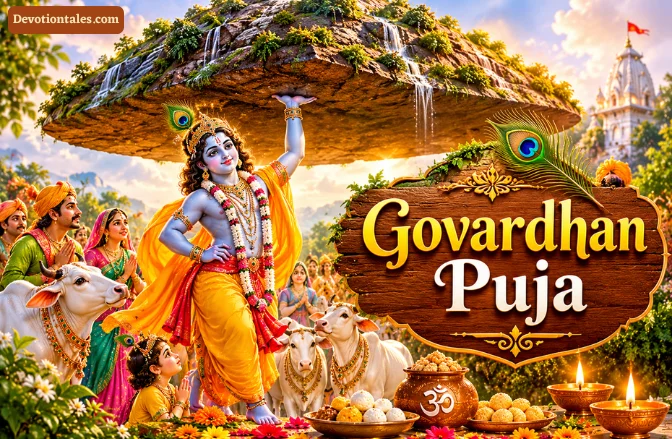
The Govardhan Puja Mantra sits at the very heart of one of Hinduism’s most beloved festivals. Every year, the day after Diwali, millions of devotees gather — in Braj and across the world — to worship Govardhan Hill and honor the moment when the young Lord Krishna lifted an entire mountain on the tip of his little finger to shield the people of Gokul from Indra’s wrath.
For anyone planning to perform Govardhan Puja at home or at a temple, knowing the correct mantras, their Sanskrit origins, their precise meaning, and the right way to chant them makes all the difference. This guide brings together the authentic Sanskrit texts sourced from the Padma Purana, their transliterations, word-by-word meanings, a clear Puja Vidhi, the Muhurat for 2025 and 2026, regional traditions, and the do’s and don’ts of observing this day correctly.
About Govardhan Puja: History and Background
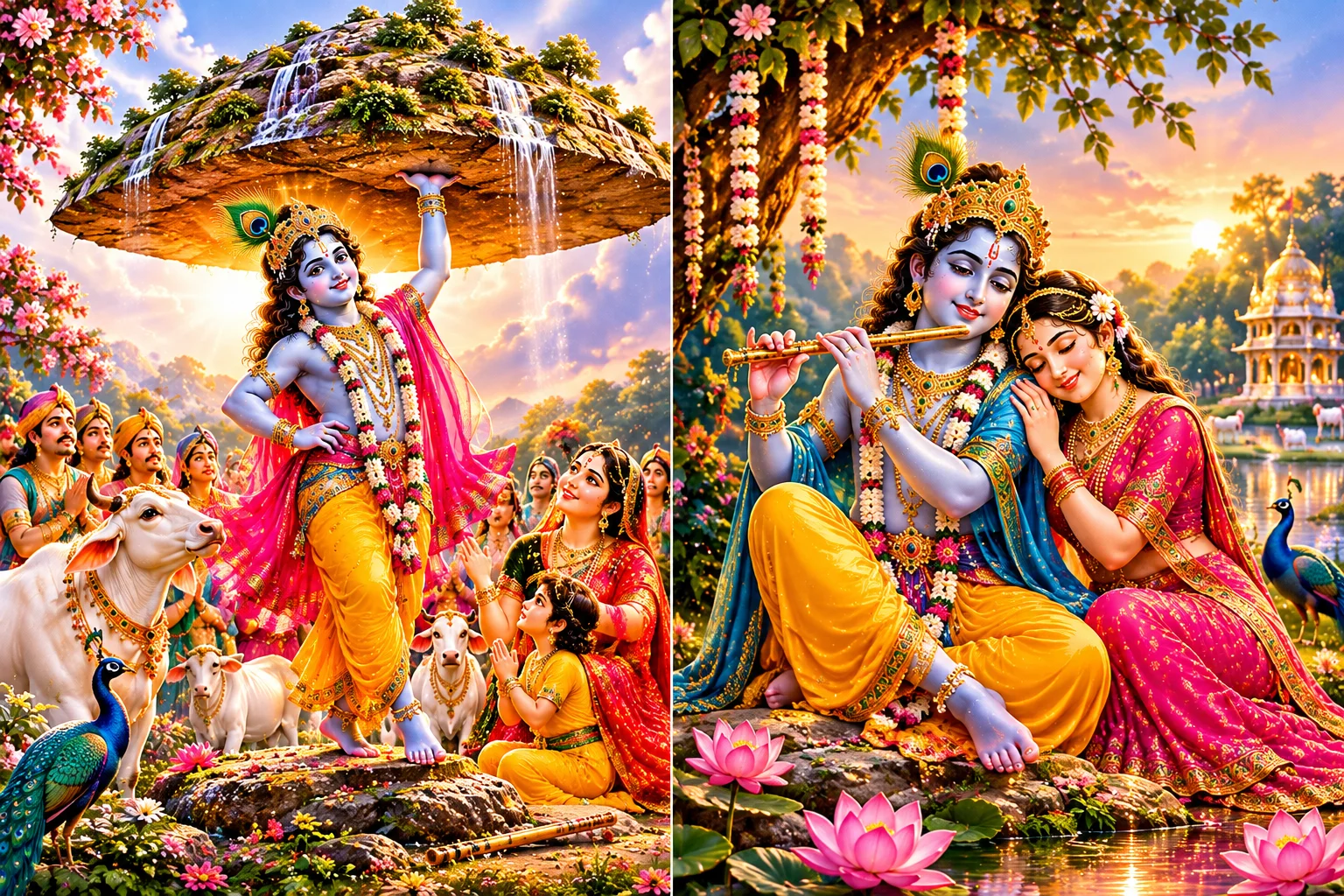
Govardhan Puja, also widely celebrated as Annakut Puja, is observed on the Pratipada (first day) of Kartik Shukla Paksha — the morning that follows Diwali’s main night. The festival commemorates one of the most iconic episodes of Lord Krishna’s life, narrated in both the Bhagavata Purana and the Harivamsa.
The people of Gokul traditionally performed a grand yagna in honor of Indra, the king of the gods, to invoke rains for their crops. The young Krishna — recognizing that it was Govardhan Hill and the cows that actually sustained the community — redirected this worship. He convinced Nanda Maharaj and the villagers to honor the hill and the cows instead.
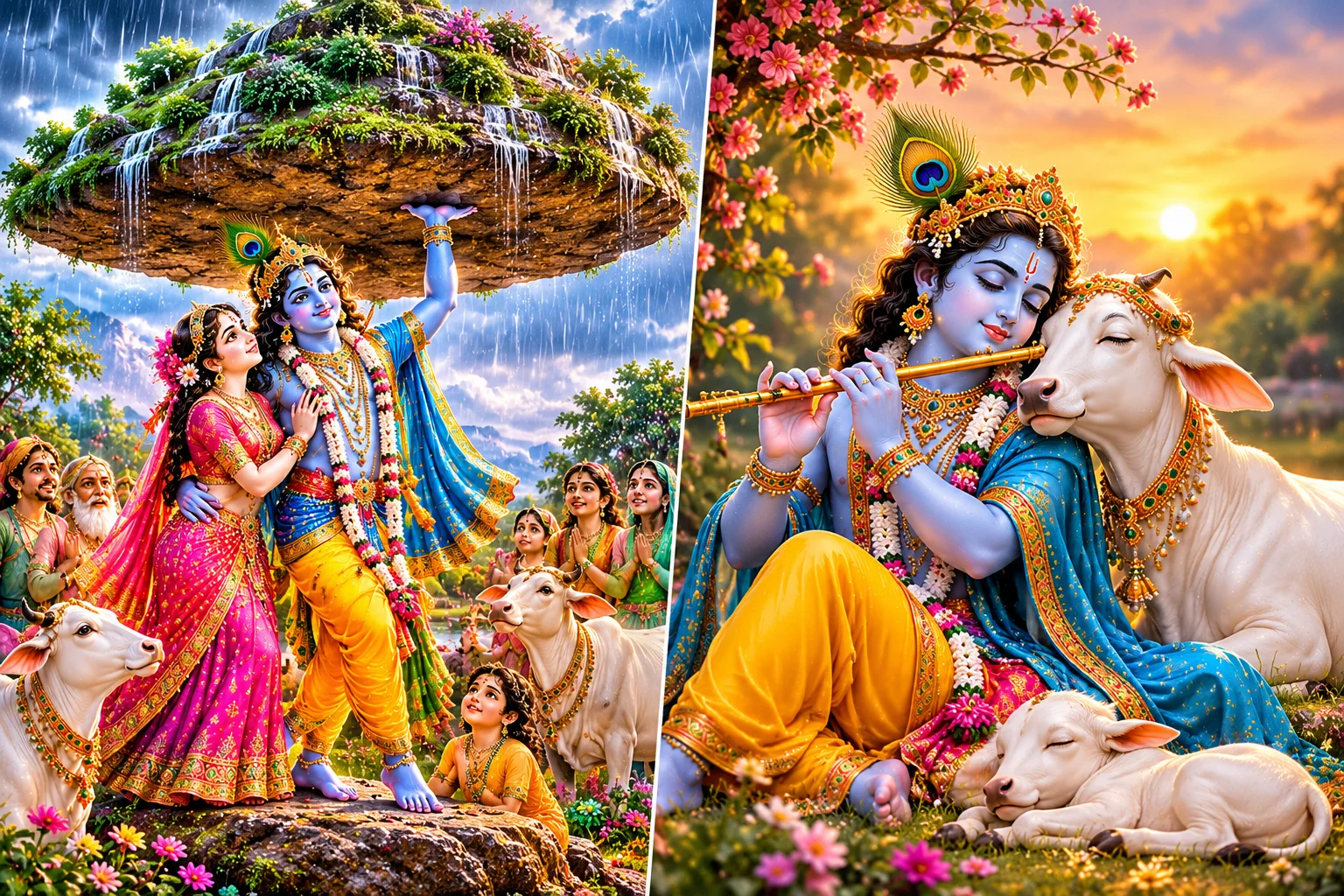
Indra, stung by this, unleashed devastating rains and storms upon Gokul. Without hesitation, Krishna lifted the entire Govardhan Hill on the little finger of his left hand and held it aloft for 7 days and nights, sheltering every villager, every cow, and every living creature beneath it. Humbled, Indra finally bowed before Krishna.
The lesson runs deeper than the miraculous act itself: honor what genuinely sustains life, and understand that true devotion to God is worth more than the appeasement of any external power. The Govardhan Hill is therefore not just a mountain — it is Giriraja, the King of Mountains, an embodiment of Krishna’s sheltering grace.
The tradition of building a symbolic mountain from cow dung or food, offering Chhappan Bhog (56 varieties of food), worshipping cows, and performing parikrama all trace directly back to this story.
Why 56 Items? The Story Behind Chhappan Bhog
One of the most-asked questions about Govardhan Puja is: why exactly 56 food items?
The traditional explanation connects to the 7-day episode itself. Krishna ordinarily ate 8 meals a day. When he held up Govardhan Hill for 7 days without eating, he skipped 7 × 8 = 56 meals. After Indra’s surrender, the gopis and the people of Gokul prepared 56 dishes to compensate for every meal Krishna had missed — and offered them all at once. This became the Chhappan Bhog tradition.
The 56 items typically include a range of sweets (such as peda, ladoo, barfi, halwa), savory preparations, fruits, dry fruits, chutneys, pickles, flatbreads, rice dishes, and dairy-based delicacies. The exact list varies by region and family tradition, but the number 56 remains constant as a symbol of complete, unconditional offering.
Govardhan Puja Mantra in Sanskrit
The 2 principal mantras of Govardhan Puja are drawn from the Padma Purana, Uttara Khanda (6.122.29–31), which describes the proper worship of Govardhan Hill and cows on the morning after Diwali.
1. Govardhan Dharan Mantra (Primary Mantra for Govardhan Hill)
This is the core mantra recited while worshipping the symbolic Govardhan Hill and during parikrama.
Sanskrit (Devanagari):
गोवर्धन धराधार गोकुलत्राणकारक।
विष्णुबाहुकृतोच्छ्राय गवां कोटिप्रदो भव॥
English Transliteration:
Govardhana dharadhara gokulatranakaraka।
Vishnubahukrtochhraya gavam kotiprado bhava॥
English Meaning:
O Govardhan — supporter of the earth, protector of Gokula!
You who were raised high by the arm of Lord Vishnu (Krishna), may you bless us with crores of cows (boundless abundance).
Hindi Meaning:
हे गोवर्धन! तुम पृथ्वी के आधार हो, गोकुल के रक्षक हो।
जो विष्णु (श्रीकृष्ण) की भुजाओं द्वारा ऊपर उठाए गए, वे हमें करोड़ों गायों का (अपार समृद्धि का) आशीर्वाद दें॥
Word-by-Word Meaning
| Sanskrit Word | Meaning |
|---|---|
| गोवर्धन (Govardhana) | Nourisher of cows (Go = cows; vardhana = nourishment/increase) |
| धराधार (dharadhara) | Supporter of the earth (dhara = earth; adhara = support/base) |
| गोकुलत्राणकारक (gokulatranakaraka) | Protector of Gokula (trana = protection; karaka = one who does) |
| विष्णुबाहु (Vishnubahu) | The arm of Vishnu — referring to Krishna |
| कृतोच्छ्राय (krtochhraya) | Raised upward (krta = done; uchhraya = elevation) |
| गवां कोटिप्रदो भव (gavam kotiprado bhava) | May you grant crores of cows (boundless blessings) |
2. Gau Puja Mantra (Mantra for Cow Worship)
Recited while offering tilak, garlands, and fodder to cows. It addresses the cow as a living form of Goddess Lakshmi — a belief rooted in Vedic understanding of the cow as the axis of an agrarian, sacred economy.
Sanskrit (Devanagari):
लक्ष्मीर्या लोकपालानां धेनुरूपेण संस्थिता।
घृतं वहति यज्ञार्थे मम पापं व्यपोहतु॥
English Transliteration:
Lakshmirya lokapalanam dhenuroopena samsthita।
Ghritam vahati yagyarthe mama papam vyapohatu॥
English Meaning:
May Goddess Lakshmi — who dwells among the guardians of the world in the form of the sacred cow
who carries ghee for the purpose of yajna — cleanse and remove all my sins.
Hindi Meaning:
लक्ष्मी देवी, जो लोकपालों के बीच गाय (धेनु) के रूप में विराजमान हैं,
जो यज्ञ के लिए घी प्रवाहित करती हैं — वे मेरे समस्त पापों को नष्ट करें॥
Word-by-Word Meaning
| Sanskrit Word | Meaning |
|---|---|
| लक्ष्मीः (Lakshmih) | Goddess Lakshmi — bestower of prosperity |
| लोकपालानाम् (lokaplananam) | Among the guardians of the world |
| धेनुरूपेण (dhenuroopena) | In the form of a cow (dhenu = cow; roopa = form) |
| संस्थिता (samsthita) | Established/dwelling |
| घृतम् (ghritam) | Ghee (clarified butter) |
| वहति (vahati) | Carries/flows |
| यज्ञार्थे (yagyarthe) | For the purpose of yajna (sacred ritual) |
| मम पापम् (mama papam) | My sins |
| व्यपोहतु (vyapohatu) | May it remove/cleanse |
3. Krishna Mool Mantra (Chanted During Annakut Offering)
Sanskrit (Devanagari):
ॐ कृष्णाय वासुदेवाय हरये परमात्मने।
प्रणतः क्लेशनाशाय गोविन्दाय नमो नमः॥
English Transliteration:
Om Krishnaya Vasudevaya Haraye Paramatmane।
Pranatah kleshsnashaya Govindaya namo namah॥
English Meaning:
Om — salutations to Krishna, son of Vasudeva, the remover of suffering, the Supreme Soul.
I bow before Govinda, destroyer of all afflictions — again and again, I offer my salutations.
Hindi Meaning:
ॐ — श्रीकृष्ण को, वासुदेव के पुत्र को, दुखों को हरने वाले परमात्मा को नमस्कार।
क्लेशों का नाश करने वाले गोविंद को प्रणाम, बार-बार प्रणाम॥
4. Govardhan Dharam Vande (Vaishnava Parikrama Prayer)
Chanted during Govardhan parikrama. Sri Chaitanya Mahaprabhu is recorded in the Chaitanya Charitamrita as having chanted this verse during his own parikrama of Govardhan Hill.
Sanskrit (Devanagari):
गोवर्धन धरं वन्दे
गोपालं गोपरूपिणम्।
गोकुलत्राणकारं च
गोविन्दं गोकुलप्रियम्॥
English Transliteration:
Govardhana dharam vande
Gopalam goparupinam।
Gokulatranakaranm cha
Govindam gokulapriyam॥
English Meaning:
I honor Krishna who holds Govardhan Hill
who appears in the form of a cowherd.
He who protects Gokula from harm
Govinda, the beloved of Gokula — I bow to him.
Hindi Meaning:
मैं उन गोविंद को प्रणाम करता/करती हूँ जिन्होंने गोवर्धन धारण किया,
जो गोपाल और गोप-रूप धारक हैं,
जो गोकुल के रक्षक हैं और गोकुल के प्रियतम हैं।
5. Hare Krishna Maha Mantra (Kirtan During Govardhan Parikrama)
This is the most universally chanted mantra during the Annakut celebration and Govardhan parikrama kirtan. It is rooted in the Kali-Santarana Upanishad and has been central to Vaishnava worship for centuries.
Sanskrit (Devanagari):
हरे कृष्ण हरे कृष्ण कृष्ण कृष्ण हरे हरे।
हरे राम हरे राम राम राम हरे हरे॥
English Transliteration:
Hare Krishna Hare Krishna Krishna Krishna Hare Hare।
Hare Rama Hare Rama Rama Rama Hare Hare॥
English Meaning:
O Hare (the energy of the Lord), O Krishna, O Rama — I call upon you, again and again.
This mantra is not a request for a specific blessing but a complete surrender — an invocation of the divine names themselves as a path to liberation.
Hindi Meaning:
हे हरे (भगवान की शक्ति), हे कृष्ण, हे राम — मैं बार-बार आपका स्मरण करता/करती हूँ।
यह मंत्र किसी विशेष फल की याचना नहीं, बल्कि दिव्य नामों में पूर्ण समर्पण है।
6. Om Namo Bhagavate Vasudevaya (The 12-Syllable Maha Mantra)
Chanted 108 times during the Annakut offering, this 12-syllable mantra is among the most revered Krishna mantras in Vaishnava tradition, rooted in the Bhagavata Purana.
Sanskrit (Devanagari):
ॐ नमो भगवते वासुदेवाय
English Transliteration:
Om Namo Bhagavate Vasudevaya
English Meaning:
I bow before the Lord who is Vasudeva — the all-pervading, Supreme Being who possesses all divine qualities.
Hindi Meaning:
भगवान वासुदेव को नमस्कार — मैं सर्वव्यापी भगवान श्रीकृष्ण के सामने अपना शीश झुकाता/झुकाती हूँ।
Govardhan Puja Vidhi (Step-by-Step)
What You Will Need:
- Fresh cow dung (gobhar) for the Govardhan mound
- Flowers, marigold garlands, and tulsi leaves
- Roli, akshat, kumkum, and sandalwood paste
- Incense sticks and oil lamp (diya)
- Panchamrit (milk, curd, honey, ghee, sugar syrup)
- Annakut — cooked seasonal food offerings
Step 1 — Prepare the Govardhan Mound
Create a small mound using fresh cow dung in your courtyard or puja space. This represents Govardhan Hill. Decorate it with fresh flowers and tulsi leaves, and place a small figure or image of Lord Krishna nearby.
Step 2 — Invoke Lord Ganesha
Begin with a short prayer to Lord Ganesha before the main puja commences.
Step 3 — Offer Panchamrit and Flowers
Offer the panchamrit to the Govardhan mound. Place flowers, akshat, kumkum, and sandalwood paste. Light the incense and diya.
Step 4 — Chant the Govardhan Mantra
With folded hands, recite the Govardhan Dharan Mantra clearly:
गोवर्धन धराधार गोकुलत्राणकारक।
विष्णुबाहुकृतोच्छ्राय गवां कोटिप्रदो भव॥
Step 5 — Perform Parikrama
Circumambulate the Govardhan hillock clockwise — 3, 5, or 7 times — while chanting Krishna’s name or the Govardhan Dharam Vande verse.
Step 6 — Offer Annakut (Chhappan Bhog)
Arrange cooked food before the Govardhan hill and Krishna’s image. Chant Om Namo Bhagavate Vasudevaya while making the offering. Place a tulsi leaf on each dish.
Step 7 — Worship the Cow
Offer fodder, garlands, and tilak to cows. While doing so, chant the Gau Puja Mantra:
लक्ष्मीर्या लोकपालानां धेनुरूपेण संस्थिता।
घृतं वहति यज्ञार्थे मम पापं व्यपोहतु॥
Step 8 — Distribute Prasad
Share the Annakut prasad with family members, neighbors, and visitors. The act of sharing food is itself considered deeply meritorious on this day.
Govardhan Puja Date, Time, and Muhurat
Govardhan Puja falls on Kartik Shukla Pratipada — the day immediately following the main night of Diwali. The puja is performed during the Pratahkala Muhurat (morning window, post-sunrise) or the Sayankala Muhurat (late-afternoon window).
Govardhan Puja 2025
| Detail | Information |
|---|---|
| Date | October 22, 2025 (Wednesday) |
| Tithi | Kartik Shukla Pratipada |
| Pratahkala Muhurat | 6:26 AM to 8:42 AM |
| Duration | 2 hours 16 minutes |
| Sayankala Muhurat | 3:29 PM to 5:44 PM |
| Pratipada Tithi Begins | 5:54 PM on October 21 |
| Pratipada Tithi Ends | 8:16 PM on October 22 |
Govardhan Puja 2026
| Detail | Information |
|---|---|
| Date | November 10, 2026 (Tuesday) |
| Tithi | Kartik Shukla Pratipada |
| Pratahkala Muhurat (Delhi) | 6:40 AM to 8:50 AM |
| Duration | 2 hours 10 minutes |
| Pratipada Tithi Begins | 12:31 PM on November 9, 2026 |
| Pratipada Tithi Ends | 2:00 PM on November 10, 2026 |
Note: Muhurat timings vary by city. Always confirm with a local Panchang or trusted temple for your specific location.
Govardhan Parikrama: The Sacred 21 km Circumambulation
For lakhs of pilgrims, Govardhan Parikrama is the defining act of this festival. The actual Govardhan Hill in Mathura district, Uttar Pradesh, sits at the center of a parikrama path that stretches approximately 21 kilometers around it. Completing this circuit on foot — barefoot for many devotees — is considered one of the most meritorious acts in Vaishnava tradition.
The parikrama passes through several sacred sites: Mansi Ganga (a sacred lake), Kusum Sarovar, Radha Kund, and the main Govardhan village where Krishna himself is said to have performed the original puja. Vaishnava texts state that even a single parikrama of Govardhan carries the merit of multiple pilgrimages.
For those who cannot travel to Vrindavan, the symbolic parikrama performed at home — circling the cow-dung Govardhan mound 7 times — honors the same intent. The mantra chanted during this home parikrama is:
गोवर्धन धरं वन्दे गोपालं गोपरूपिणम्।
गोकुलत्राणकारं च गोविन्दं गोकुलप्रियम्॥
Govardhan Puja Do’s and Don’ts
Knowing what to avoid is as important as knowing what to do, especially for first-time observers.
Do’s
- Perform the puja within the Pratahkala or Sayankala Muhurat for maximum auspiciousness
- Use fresh, clean cow dung to create the Govardhan mound — this is considered the authentic method
- Offer tulsi leaves with every dish in the Annakut, as Krishna is especially pleased by tulsi
- Worship cows with respect and offer them fresh fodder, grass, and jaggery on this day
- Chant Krishna’s names or mantras continuously during parikrama — silence during circumambulation reduces its spiritual quality
- Share the Annakut prasad generously — the tradition of community feeding is central to this festival’s meaning
- Light a lamp (diya) throughout the puja
Don’ts
- Do not consume non-vegetarian food on Govardhan Puja day
- Do not perform the puja during Amavasya Tithi — wait for Pratipada Tithi to begin
- Do not use artificial or plastic materials for the Govardhan mound; cow dung or natural clay is traditional
- Do not break the parikrama once started; complete it fully without interruption
- Do not purchase or cook food as routine — the food prepared is an offering first, prasad second
- Avoid arguments, harsh words, and negative speech on this day, which is considered a day of gratitude and community
Spiritual Significance of the Govardhan Puja Mantra
Govardhan as Giriraja: The word “Govardhana” carries a dual meaning. At the literal level, Go means cows and vardhana means that which nourishes and increases. At the deeper level, Go also refers to the senses, and vardhana means that which redirects their energy toward Krishna. The hill thus represents both physical nourishment and spiritual elevation.
The arm of Vishnu: The phrase Vishnubahukrtochhraya — “raised by the arm of Vishnu” — is theologically precise. It affirms that the cowherd Krishna who lifted the hill is none other than Vishnu himself, the Supreme Being, acting not from a distant cosmic throne but as a present, tangible protector.
The cow as Lakshmi: The Gau Puja Mantra addresses the cow as a form of Goddess Lakshmi dwelling among the world’s guardians. In Vedic understanding, the cow provided milk, ghee for sacred fires, dung that enriched the earth, and urine used in purification. Honoring the cow on this day is an acknowledgment of this complete, living ecosystem of abundance.
Govardhan as the original ecology teaching: Krishna’s decision to redirect worship from Indra toward the hill and the cows that sustained Gokul was not an act of theological rebellion. It was a teaching: gratitude must be directed toward what actually serves life, not toward fear of what might harm it. This message resonates as much today as it did in Dvapara Yuga.
How Govardhan Puja Is Celebrated Across India
The festival takes a strikingly different shape depending on where in India it is observed:
Mathura and Vrindavan (Uttar Pradesh): The epicenter of the celebration. The actual Govardhan Hill draws hundreds of thousands of pilgrims for the 21 km parikrama. ISKCON temples in Vrindavan hold massive Annakut displays — sometimes with thousands of food items — and kirtan runs through the night.
Maharashtra: The day is celebrated as Bali Pratipada or Padwa — the first day of the new year in the Marathi calendar. Husbands traditionally give gifts to their wives, and the day carries a distinct celebratory character alongside the Govardhan worship.
Gujarat: Observed as Gujarati New Year (Bestu Varas), coinciding with the Govardhan Puja date. Businesses open their new account books (chopda pujan), and the festival carries strong commercial and familial significance.
Punjab and Haryana: Known as Annakut — the emphasis is on preparing an enormous spread of cooked food to offer to Krishna before distributing it to the community as prasad.
Bengal: Some communities observe this as Govardhan Chaturdashi with specific rituals tied to cow worship and community feasts, though the main four-day Diwali sequence is observed somewhat differently here.
Traditional Spiritual Benefits of Govardhan Puja Mantras
Traditional texts associate sincere observance of this puja with meaningful inner and outer benefits — expressed here as beliefs and devotional understanding, not guaranteed outcomes.
Reciting the Govardhan Dharan Mantra is believed to invoke Giriraja’s protection over the household, mirroring the shelter Krishna himself provided. The Gau Puja Mantra is associated in tradition with Lakshmi’s grace — the removal of karmic debt and the cultivation of abundance. Offering Annakut reflects the spirit of genuine gratitude that Krishna originally called the people of Gokul toward. Parikrama — physical or symbolic — is considered deeply meritorious in Vaishnava texts, and chanting Om Namo Bhagavate Vasudevaya 108 times is practiced across all Vaishnava traditions as a direct path to Krishna’s presence.
Conclusion
The Govardhan Puja Mantra is more than a chant — it is an act of remembrance. It calls to mind the moment when Krishna, the cowherd of Vrindavan, stood between his people and a storm, offering not distance but nearness. Each verse in this tradition asks us to see the sacred in the soil beneath our feet, in the cow that nourishes us, and in the hill that simply stands.
Whether you chant the Govardhan Puja Mantra in Sanskrit at the actual Govardhan Hill, follow the transliteration at a home altar, or observe from anywhere in the world, the spirit remains the same: gratitude, devotion, and trust in divine shelter.
This Govardhan Puja, may Giriraja’s grace and Govinda’s protection be with you and your family.
Explore more devotional mantras, puja guides, and Sanskrit shlokas at Devotion Tales.
🔔 Also explore these mantras & shlokas:
- Shiv Dhyan Mantra
- Aaj Ka Sankalp Mantra
- Shree Swami Samarth Tarak Mantra
- Karagre Vasate Lakshmi Mantra
- Shri Kamal Netra Stotra
- Shatru Nashak Mantra
- Maa Parvati Panchak Stotra
- Sai Kasht Nivaran Mantra
- Gupt Navratri 2026
- Baglamukhi Mantra
- Chandra Beej Mantra
- Ketu Beej Mantra
- Budh Beej Mantra
- Bhog Lagane Ka Mantra
- Shri Sankat Nashan Ganesh Stotra
- Om Sarva Badha Vinirmukto Mantra
FAQs About Govardhan Puja Mantra
Q1. What is the main Govardhan Puja Mantra?
Govardhana dharadhara gokulatranakaraka | Vishnubahukrtochhraya gavam kotiprado bhava — from the Padma Purana, addressed directly to Govardhan Hill.
Q2. When is Govardhan Puja 2025?
October 22, 2025 (Wednesday), with the Pratahkala Muhurat from 6:26 AM to 8:42 AM.
Q3. When is Govardhan Puja 2026?
November 10, 2026 (Tuesday), with the Pratahkala Muhurat (Delhi) from 6:40 AM to 8:50 AM.
Q4. What mantra is chanted while worshipping cows?
Lakshmirya lokapalanam dhenuroopena samsthita | Ghritam vahati yagyarthe mama papam vyapohatu — addressing the cow as Goddess Lakshmi.
Q5. How many times should the Govardhan mantra be chanted?
Chant Om Namo Bhagavate Vasudevaya 108 times during the Annakut offering. The Govardhan Dharan Mantra has no fixed count — chant it with sincerity during worship and parikrama.
Q6. Why is 56 items of food offered on Govardhan Puja?
Krishna ate 8 meals a day. He fasted for 7 days while holding up the hill, missing 56 meals. The devotees prepared 56 dishes afterward as a loving offering to compensate for each missed meal.
Q7. How long is the Govardhan parikrama at the actual hill in Mathura?
The traditional Govardhan parikrama route is approximately 21 kilometers, passing through several sacred spots including Mansi Ganga, Kusum Sarovar, and Radha Kund.
Q8. Can Govardhan Puja be performed at home without cow dung?
Yes. The hill can be shaped from natural clay or even represented by a mountain of food. Cow dung is considered traditional and most auspicious, but the sincerity of the devotion matters most.
