
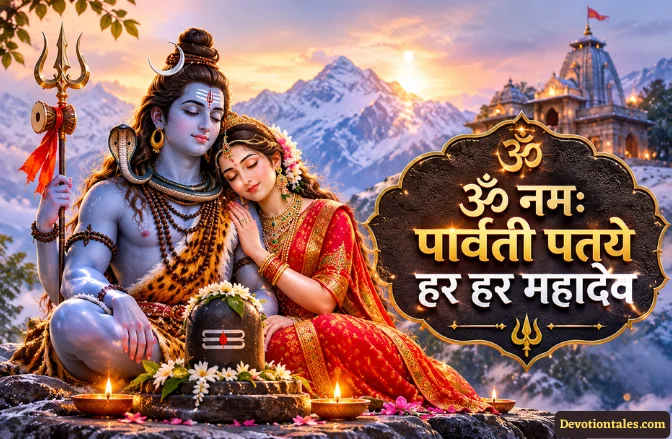
Om Namah Parvati Pataye Har Har Mahadev Mantra is one of the most powerful Shiva invocations in Hindu devotion. It opens with a humble bow to Lord Shiva as the husband of Maa Parvati, then rises into the thunderous cry of “Har Har Mahadev” that echoes from Kashi to the Himalayas. Millions of pilgrims and devotees have used these 6 words across centuries.
This guide covers the Sanskrit text, word-by-word breakdown, full English and Hindi meaning, why “Har” is repeated twice, and a simple guide on when and how to chant.
Om Namah Parvati Pataye Har Har Mahadev Mantra In Sanskrit
The invocation in Devanagari:
ॐ नमः पार्वतीपतये हर हर महादेव॥
Simple Roman transliteration (easy to read aloud):
Om Namah Parvati Pataye, Har Har Mahadev
IAST transliteration (scholarly):
Oṃ namaḥ pārvatīpataye, hara hara mahādeva
The first part follows Sanskrit’s standard salutation pattern: namah (salutation) is always followed by the dative case of the deity being honored, so pārvatīpataye means “to the Lord of Parvati.” The closing “Har Har Mahadev” is a devotional exclamation, not a grammatical continuation, which is why it flows like a cheer or a war cry.
Pronunciation Guide
| Word | Say It Like This |
|---|---|
| Om | Long, rounded “oam”; breath out slowly on “m” |
| Namah | “nuh-muh-huh”; soft breath on the final “h” |
| Parvati | “paar-vuh-tee”; stress on “paar” |
| Pataye | “puh-tuh-yay” |
| Har | Short and sharp, like “hara” clipped; not “haar” |
| Mahadev | “muh-haa-dayv”; “haa” is long |
Note on Har vs. Hara: When chanted fast in a crowd, it sounds like “Har Har.” In classical Sanskrit pronunciation, it is “Hara Hara,” with a short “a” at the end. Both are correct. The short form is used in devotional chanting; the full form appears in scholarly texts.
Word-by-Word Meaning
| Sanskrit | Roman | English Meaning | हिंदी अर्थ |
|---|---|---|---|
| ॐ | Om | The primal sound; the sacred syllable that opens all mantras | मंत्र का पवित्र आरंभ, आदि नाद |
| नमः | Namah | Salutation, humble bowing | नमस्कार, विनम्र प्रणाम |
| पार्वतीपतये | Parvati-pataye | To the Lord (husband) of Parvati | पार्वती के पति को |
| हर | Hara | The Remover; a name of Shiva who takes away suffering | हरने वाले, दुख हरने वाले शिव |
| हर | Hara | Repeated for emphasis and devotional intensity | दोबारा, भावपूर्ण जोर के लिए |
| महादेव | Mahadeva | The Great God, greatest among all gods | महान देव, देवों के देव |
Sanskrit grammar note: Parvati-pati is a compound word. Parvata means mountain; Parvati means “daughter of the mountain” (referring to Himavat, the king of the Himalayas). Pati means lord or husband. The dative ending -taye is required after namah, turning it into “to the Lord of Parvati.” This grammar is what makes the salutation technically correct in Sanskrit.
Full Meaning in English and Hindi
English meaning:
“I bow to Lord Shiva, the consort of Parvati. Victory to Hara, victory to Hara, the Great God.”
Hindi meaning:
“मैं पार्वती के पति भगवान शिव को नमन करता हूँ। हे हर, हे हर, हे महादेव, आपकी जय हो।”
The invocation carries 2 distinct movements. The first half is personal and quiet: a devotee bowing to the God who chose to be a householder, a husband, and a partner. The second half is communal and joyful: a collective shout of faith that belongs to processions, pilgrimages, and festivals.
Why Is “Har” Said Twice?
“Har Har” is not a simple repetition for rhythm. There are 3 layers to it:
1. It is a devotional intensifier. In Sanskrit and in spoken Hindi-Urdu, repeating a word doubles its force. “Har Har” means not just “O Remover” but “You who remove all things, again and again.” It is like saying “You are the Remover, forever and always.”
2. It points to the two faces of Shiva’s power. The first “Har” is Shiva removing inner suffering: ego, fear, and attachment. The second “Har” is Shiva removing outer suffering: obstacles, enemies, and misfortune. Devotees in the Shaiva tradition describe this as the dual action of grace.
3. It echoes the rhythm of a heartbeat and a drum. The damaru (Shiva’s small drum) beats in pairs: dhim-dhim. “Har Har” mirrors that rhythm. Chanting it out loud with that two-beat pulse is itself a small act of worship.
This is why “Har Har Mahadev” feels different from “Jai Mahadev.” The doubling is deliberate and meaningful.
Why This Mantra Uses Parvati’s Name, Not Shiva’s Own Names
Shiva has 1008 names. So why does this invocation define him through Parvati?
It is not an accident. In the Shaiva tradition, addressing Shiva as “Parvati Pati” does something specific: it invokes the gentler, most accessible aspect of an otherwise infinite and terrifying God. The fierce Shiva of cremation grounds and the ascetic Shiva of Mount Kailash can feel distant. But Shiva the husband, the one who carried Sati’s body, who waited for Parvati through her austerities, who calls her “Shakti” and considers her his equal, is the God a household worshipper can approach.
Calling him “Lord of Parvati” is essentially saying: “I come to you through her.” Maa Parvati is considered the most powerful intercessor in the Shaiva tradition. This is also why temples dedicated to both Shiva and Parvati are called Ardhanarishvara temples: they represent the two as literally one body, inseparable.
If you wish to understand Parvati’s devotional power further, the Maa Parvati Panchak Stotra on Devotion Tales is a good next read.
The Kashi Connection: Why This Is the Official Greeting of Varanasi
Om Namah Parvati Pataye Har Har Mahadev is not just a personal mantra. It is the living heartbeat of Varanasi (Kashi), the holiest city in Hinduism and one of the oldest continuously inhabited cities in the world.
In Kashi, “Har Har Mahadev” is used as a greeting the way people elsewhere say “hello.” Shopkeepers, boatmen, priests, and pilgrims open and close every exchange with it. This practice is deeply intentional: Kashi is considered the city where Shiva himself resides as the lord, and every interaction in the city is considered a form of worship.
The Kashi Vishwanath temple, one of the 12 Jyotirlinga temples of Shiva, is the spiritual center of this tradition. Pilgrims who travel to Kashi typically chant this invocation from the moment they enter the city. It is also the chant that fills the ghats during the Ganga Aarti at dawn and dusk.
It is a living, street-level cry that has been chanted continuously in one city for more than 3000 years.
Om Namah Parvati Pataye Har Har Mahadev vs Om Namah Shivaya: What Is the Difference?
Both are Shiva mantras, but they are built differently and serve different purposes.
| Feature | Om Namah Parvati Pataye Har Har Mahadev | Om Namah Shivaya |
|---|---|---|
| Sanskrit source | Devotional invocation; no verified scripture | Shri Rudram, Krishna Yajurveda |
| Structure | Salutation + devotional cheer | The Panchakshara (5-syllable) mantra |
| Tone | Personal bow, then collective celebration | Meditative, inward, contemplative |
| Use | Festivals, processions, group chanting, pilgrimage | Personal japa, meditation, puja |
| Focus | Shiva as husband of Parvati | Shiva’s 5 elements (earth, water, fire, air, sky) |
| Best for | Energetic devotion, loud chanting, pilgrimages | Quiet daily practice, rosary, meditation |
Neither is superior. They complement each other. Many devotees use Om Namah Shivaya during morning japa and “Har Har Mahadev” during Shiva festivals or temple visits.
Om Namah Parvati Pataye Namah Variant
Some devotees chant a shorter version that closes with a second salutation:
ॐ नमः पार्वतीपतये नमः॥
Transliteration: Om Namah Parvati Pataye Namah
English meaning: Om, salutations again and again to the Lord of Parvati.
Hindi meaning: ॐ, पार्वती के पति भगवान शिव को बार-बार नमस्कार है।
This form is used in some temple rituals and in certain Shaiva traditions where the chant is meant to begin and end with a bow rather than with a shout. It is quieter and more meditative in character. The choice between the two depends entirely on the occasion: the “Namah” ending for personal worship, the “Har Har Mahadev” ending for group devotion.
When and How to Chant
No scripture fixes a mandatory time or count for this invocation. The following are practices that devotees traditionally follow, not compulsory rules.
Occasions traditionally linked to this mantra:
- Monday (Somvar): the weekday of Shiva; most Shiva temples do extra puja on Mondays
- Pradosh Vrat: the 13th lunar day, twice a month, considered especially auspicious for Shiva worship
- Mahashivratri: the most important Shiva festival; this chant is heard non-stop from dusk to dawn
- Shravan month: the entire monsoon month is dedicated to Shiva; millions do Kanwar Yatra chanting this invocation
- Kanwar Yatra: pilgrims carry Ganga water on a decorated carrier (kanwar) from Haridwar or other Ganga sites to their local Shiva temple, chanting this the entire way, sometimes walking 100 kilometers or more
A simple 5-step practice:
- Sit comfortably and take 3 slow breaths to settle the mind.
- Look at an image of Shiva and Parvati together, or close your eyes and picture them.
- Begin slowly, giving each word its full sound: Om… Namah… Parvati Pataye… Har Har Mahadev.
- Increase speed gradually if it feels natural. If using a rudraksha mala, 108 beads is traditional, but any number works.
- Sit quietly for 1 to 2 minutes at the end before returning to daily activity.
On using a mala: A rudraksha mala is especially associated with Shiva worship. The beads come from the rudraksha tree, whose seeds are said in the Puranas to have formed from Shiva’s tears. Using one while chanting this invocation is a small act of alignment with the tradition.
Traditional Spiritual Benefits
Devotees across centuries have described these experiences. They are personal and traditional, not medical guarantees.
- Removal of fear: “Hara” literally means “the one who removes.” Chanting this name is traditionally understood as asking Shiva to remove fear, grief, and ego.
- Peace in the home: Since the invocation honors Shiva and Parvati as an ideal couple, many families chant it together to bring harmony into the household.
- Protection on journeys: Kanwar pilgrims and Kashi yatris chant it specifically for protection during travel. It has long been associated with safe passage.
- Mental steadiness: The two-beat rhythm of “Har Har” creates a natural, calming cadence when chanted with slow breath. Many devotees describe feeling more grounded after even 5 minutes of chanting.
- Sense of community: The two-beat call of “Har Har” is naturally communal. It is built for groups, processions, and open spaces, which is why it has thrived in pilgrimage culture for centuries.
For a Devotion Tales guide on prayer during difficult times, see the Om Sarva Badha Vinirmukto Mantra.
Om Namah Parvati Pataye Har Har Mahadev In Hindi
Written in Devanagari:
ॐ नमः पार्वती पतये हर हर महादेव
Hindi writers often place a space between “पार्वती” and “पतये” for readability. Classical Sanskrit writes them joined as one compound: “पार्वतीपतये.” Both spellings carry the same meaning.
Hindi meaning:
मैं पार्वती के पति भगवान शिव को प्रणाम करता हूँ।
हर हर महादेव, अर्थात हे दुखों को हरने वाले महादेव, आपकी जय हो।
Conclusion
Om Namah Parvati Pataye Har Har Mahadev Mnatra is far more than a catchy chant. It is a 6-word theology: a bow to Shiva’s gentlest face, a call to his greatest power, and a cheer that has been echoing in Kashi for millennia. The first half brings you close; the second half opens you outward. Chant it slowly to understand it, and loudly to feel it. Har Har Mahadev. Explore more mantras and their meanings on Devotion Tales.
🔔 Also explore these mantras & shlokas:
- Shiv Dhyan Mantra
- Aaj Ka Sankalp Mantra
- Shree Swami Samarth Tarak Mantra
- Karagre Vasate Lakshmi Mantra
- Shri Kamal Netra Stotra
- Shatru Nashak Mantra
- Sai Kasht Nivaran Mantra
- Gupt Navratri 2026
- Baglamukhi Mantra
- Chandra Beej Mantra
- Ketu Beej Mantra
- Budh Beej Mantra
- Bhog Lagane Ka Mantra
- Shri Sankat Nashan Ganesh Stotra
- Diwali Puja Mantra
- Shri Ram Raksha Stotra
Frequently Asked Questions
1. What is the meaning of Om Namah Parvati Pataye Har Har Mahadev?
It means “I bow to the Lord of Parvati. Victory to the Remover, victory to the Great God.”
2. Why is “Har” said twice?
“Har Har” intensifies the devotion: once for removing inner suffering (ego, fear), once for removing outer suffering (obstacles, misfortune). It also mirrors the two-beat rhythm of Shiva’s damaru drum.
3. What does Parvati Pataye mean?
Pataye is the dative form of pati (lord, husband). “Parvati Pataye” means “to the Lord of Parvati,” i.e., to Shiva.
4. Is this mantra from a scripture?
No verified Vedic or Puranic source is known. It is a traditional devotional invocation, not a quoted verse.
5. Is “Har Har Mahadev” the same as “Bol Bam”?
No. “Bol Bam” is the chant of Kanwar pilgrims specifically and addresses Shiva as Bholenath. “Har Har Mahadev” is older and broader, used in all contexts of Shiva worship. Both are heard during Shravan and Mahashivratri, which is why they are often confused.
6. Can beginners chant it?
Yes. It is short, easy to pronounce, and has no mandatory ritual requirement. Anyone can start today.
7. What is the best time to chant it?
Monday morning puja, Pradosh evenings, or any Shiva festival. For daily practice, early morning or evening works well.
8. Is there a difference between “Har Har Mahadev” and “Jai Mahadev”?
Yes. “Jai Mahadev” means “Victory to the Great God” and is a simple praise. “Har Har Mahadev” calls on Shiva’s specific power to remove and contains a double salutation. The energy and intention are different.
