
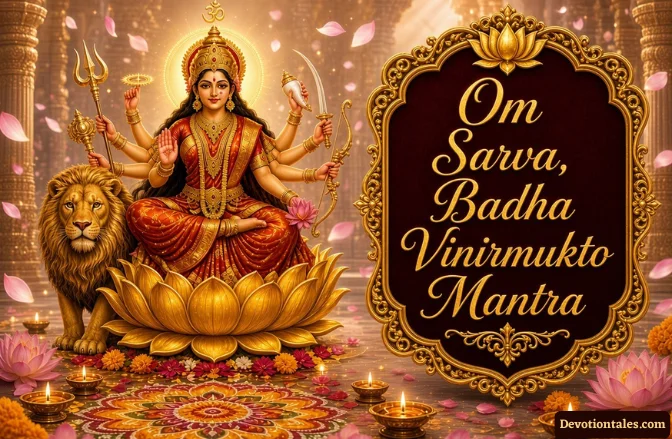
The Om Sarva Badha Vinirmukto Mantra is a Sanskrit verse in which the Divine Mother promises that a person who approaches her with devotion will be freed from hardships by her grace. People search for it in difficult times, wanting a short and steady prayer to hold on to.
The verse is spoken by the Devi herself in the Durga Saptashati, which makes it a verse of Devi worship and a close companion to Navratri prayers.
Om Sarva Badha Vinirmukto Mantra At A Glance
| Detail | Information |
|---|---|
| Mantra name | Sarva Badha Vinirmukto Mantra |
| Scripture | Devi Mahatmya (Durga Saptashati), part of the Markandeya Purana |
| Chapter | Chapter 12 (Phalashruti, “the fruits of listening”) |
| Verse number | Verse 13 of Chapter 12 |
| Speaker | The Devi (Bhagavati) |
| Language | Sanskrit |
| Metre | Anushtubh (2 lines, 32 syllables) |
| Presiding deity | Goddess Durga / Chandi |
| Chanting count in scripture | No fixed number prescribed |
| Common devotional counts | 11, 21 or 108 times |
| Time for 1 round | About 10 to 15 seconds |
| Popular occasion | Navratri, morning prayers |
Origin: Where the Verse Comes From
The Devi Mahatmya has 13 chapters and about 700 verses. By Chapter 12, the great battles against Madhu, Kaitabha, Mahishasura and Shumbha-Nishumbha are complete. The Goddess then speaks directly to the gods and explains what blessings come to those who recite and hear her deeds with devotion.
Our verse is the end of a sentence that begins in the verse before it. That earlier line speaks of the great annual worship in autumn (Sharad) and says that whoever listens to the Devi’s glory at that time with devotion receives the result described here. So it began as a promise attached to devout listening, and later grew into a chant of its own.
In the Markandeya Purana’s continuous numbering, the same verse falls in Chapter 92.
The opening “Om” is a sacred beginning that devotees add before chanting. The verse text itself begins with Sarva.
Sarva Badha Vinirmukto Mantra In Sanskrit, English and Hindi
Sanskrit (Devanagari):
ॐ सर्वाबाधाविनिर्मुक्तो धनधान्यसुतान्वितः ।
मनुष्यो मत्प्रसादेन भविष्यति न संशयः ॥
English Transliteration:
Om Sarva Badha Vinirmukto Dhana Dhanya Sutanvitah
Manushyo Matprasadena Bhavishyati Na Samshayah
English Meaning: By my grace, a person will be freed from all obstacles and blessed with wealth, grain and children. There is no doubt about this.
Hindi Meaning (हिंदी अर्थ): मेरी कृपा से मनुष्य सभी बाधाओं से मुक्त होकर धन, अन्न और संतान से संपन्न होगा। इसमें कोई संदेह नहीं है।
Variant reading: The first line is also found as dhanadhanyasamanvitah (धनधान्यसमन्वितः). The meaning is nearly the same, but it drops the explicit mention of children. The version above is the one commonly chanted.
Pronunciation tips: Say Badha as “baa-dhaa” with a soft “dh”. Read Matprasadena as two joined words, mat (my) and prasadena (by grace). End the last word, Samshayah, with a light breath.
Om Sarva Badha Vinirmukto Mantra: Word-by-Word Meaning
| Sanskrit Word | Meaning |
|---|---|
| Sarva | all, every kind of |
| Badha | obstacle, affliction, hindrance |
| Vinirmuktah | completely freed |
| Dhana | wealth |
| Dhanya | grain, food, sustenance |
| Suta | son, child |
| Anvitah | accompanied by, blessed with |
| Manushyah | a human being |
| Mat | my (the Goddess speaking) |
| Prasadena | by grace |
| Bhavishyati | will become |
| Na Samshayah | there is no doubt |
The word Vinirmuktah carries two prefixes, vi and nir, which together suggest complete release and not partial relief.
Sarva Badha Vinirmukto Mantra Meaning
The literal meaning is simple: freedom from trouble, followed by material sustenance and family.
The devotional meaning goes a little deeper. Many devotees read badha as inner obstacles too, such as fear and confusion, and read dhana-dhanya as a well-provided life and not luxury. This is a reflective reading by devotees, and the Sanskrit itself does not state it.
Two points make the verse special:
- The power sits in grace. The key word is mat-prasadena, “by my grace”. The verse puts surrender before achievement.
- The order matters. Freedom from obstacles comes first and prosperity follows, because a worried mind cannot enjoy abundance.
The closing words na samshayah, “no doubt”, also speak to a very human struggle. In hard times, doubt can weigh more than the problem itself.
Important Facts to Know
- The speaker is the Devi. The verse is the Goddess’s own assurance, so it belongs to the worship of Durga and Chandi.
- It is a verse of the Durga Saptashati. The scripture lays down no special procedure, offering or direction for it.
- It speaks of grace, not a timeline. The verse names no period, amount or fixed result.
- It is a phalashruti verse. It states the blessing that follows devout listening to the Devi’s glory.
- It differs from the Hanuman mantra of a similar name. The “Sarva Badha Mukti” Hanuman mantra belongs to Hanuman’s worship, while this verse belongs to Devi worship.
Sarva Badha Vinirmukto Mantra How Many Times
The Durga Saptashati gives no fixed number of repetitions for this verse. Counts such as 11, 21 or 108 are devotional choices followed by families and teachers.
A simple way for beginners:
- Wash your hands and face and sit in a quiet, clean place.
- Light a lamp in front of an image of Goddess Durga, if you wish.
- Take a few slow breaths.
- Chant the verse slowly. Start with 11 repetitions, or 108 with a mala if that feels natural.
- Sit in silence for a minute afterwards.
Morning is a popular time because the mind is calm, and the verse is often chanted during Navratri. Choose a time you can keep regularly, since steady practice matters more than the hour. Posture, clothing and offerings are personal choices for this verse.
Sarva Badha Vinirmukto Mantra Benefits
These are the traditional and personal benefits that devotees describe. They are matters of faith and experience, not scientifically proven or guaranteed outcomes.
- A calmer mind. A few minutes of slow chanting gives many people a pause from worry.
- Courage in difficulty. The verse reminds the devotee that the Divine Mother stands behind them.
- Gratitude for sustenance. Reciting dhana and dhanya turns attention to what already nourishes the home.
- A steady devotional habit. Two short lines are easy to repeat every day.
- Faith over doubt. The closing words encourage trust in uncertain times.
Chant it together with honest effort and practical care for health and finances. Faith supports action and does not replace it.
Related Verses From the Same Scripture
Readers who like this verse often look for other well-known verses from the Devi Mahatmya. Here is how they differ.
| Verse | Chapter | Focus |
|---|---|---|
| Sarva Badha Vinirmukto | 12 | Freedom from hardships by the Devi’s grace |
| Sarva Mangala Mangalye | 11 | Praise of the Devi as the source of all auspiciousness |
| Sarva Badha Prashamanam | 11 | Prayer to the Devi to calm all troubles of the three worlds |
| Ya Devi Sarva Bhuteshu | 5 | Salutations to the Devi present in all beings |
Do not confuse Sarva Badha Prashamanam (a prayer to calm obstacles, in Chapter 11) with Sarva Badha Vinirmukto (the Devi’s assurance, in Chapter 12). The names look alike, but the speaker and purpose differ.
Conclusion
The Om Sarva Badha Vinirmukto Mantra is a two-line promise from the Divine Mother: turn to her with devotion, and the weight of obstacles will lift. Chant it slowly, understand what you are saying, and let the words settle your mind. You can find more verified mantras and prayers with their meanings at Devotion Tales.
🔔 Also explore these mantras & shlokas:
- Shiv Dhyan Mantra
- Aaj Ka Sankalp Mantra
- Shree Swami Samarth Tarak Mantra
- Karagre Vasate Lakshmi Mantra
- Shri Kamal Netra Stotra
- Shatru Nashak Mantra
- Maa Parvati Panchak Stotra
- Sai Kasht Nivaran Mantra
- Gupt Navratri 2026
- Baglamukhi Mantra
- Chandra Beej Mantra
- Ketu Beej Mantra
- Budh Beej Mantra
- Bhog Lagane Ka Mantra
- Shri Sankat Nashan Ganesh Stotra
FAQs About Om Sarva Badha Vinirmukto Mantra
1. What is the meaning of the Om Sarva Badha Vinirmukto Mantra?
By the Goddess’s grace, a person is freed from obstacles and blessed with wealth, grain and children.
2. Which scripture is it from?
It is from Chapter 12 of the Devi Mahatmya (Durga Saptashati).
3. Who speaks this verse?
The Devi, the Divine Mother.
4. How many times should I chant it?
No fixed count exists. Many chant 11, 21 or 108 times.
5. Can beginners chant it?
Yes. Learn the pronunciation and chant slowly with devotion.
6. Does it guarantee results?
No. It is a prayer of faith with personal, spiritual benefits.
