
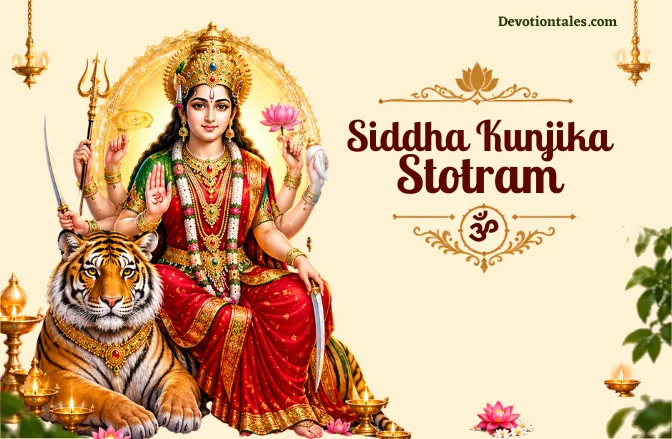
Siddha Kunjika Stotram is a divine hymn revealed by Lord Shiva to Goddess Parvati, recorded in the Gauritantra section of the Shri Rudrayamala. “Kunjika” means a key or that which unlocks; “Siddha” means accomplished. Together: the perfected key that unlocks the full spiritual power of Durga Saptashati.
Its compact structure carries the essence of the Goddess’s power through Bija mantras, divine names, and direct invocations — making every syllable charged with devotional energy.
Siddha Kunjika Stotram – Origin and Background
The Siddha Kunjika Stotram originates from the Shri Rudrayamala, an ancient Agamic Tantric scripture within the Yamala group. Within it, the Gauritantra is a dialogue between Lord Shiva and Goddess Gauri (Parvati) — a classic Tantric structure where Shiva teaches Parvati the deepest secrets of Shakti worship.
Shiva tells Parvati that Kunjika Stotra is so secret that even the gods find it difficult to obtain — “ati guhyataram devi devanam api durlabham” — and instructs her to guard it as she would guard her own life.
Siddha Kunjika Stotram and Durga Saptashati – The Connection
Durga Saptashati is a 700-verse scripture from the Markandeya Purana whose complete ritual requires Kavach, Argala, Kilaka, Ratri Sukta, Devi Sukta, Nyasa, Dhyana, and Anga Puja before the main text begins.
Shiva tells Parvati that none of these are needed when Kunjika is recited — it contains their essence. Without Kunjika, reading Saptashati alone is like crying in a forest: the effort is real, but the fruit does not come. In traditional practice, Siddha Kunjika Stotram is read before or alongside Durga Saptashati, especially during Navratri.

Siddha Kunjika Stotram In Sanskrit – Complete Text
(श्रीरुद्रयामल, गौरीतंत्र — शिव उवाच)
॥ शिव उवाच ॥
शृणु देवि प्रवक्ष्यामि कुञ्जिकास्तोत्रमुत्तमम्। येन मन्त्रप्रभावेण चण्डीजापः सिद्धिर्भवेत्॥ १॥
न कवचं नार्गलास्तोत्रं कीलकं न रहस्यकम्। न सूक्तं नापि ध्यानं च न न्यासो न च वार्चनम्॥ २॥
कुञ्जिकापाठमात्रेण दुर्गापाठफलं लभेत्। अति गुह्यतरं देवि देवानामपि दुर्लभम्॥ ३॥
गोपनीयं प्रयत्नेन स्वयोनिरिव पार्वति। मारणं मोहनं वश्यं स्तम्भनोच्चाटनादिकम्। पाठमात्रेण संसिद्ध्येत् कुञ्जिकास्तोत्रमुत्तमम्॥ ४॥
॥ अथ मन्त्रः ॥
ॐ ऐं ह्रीं क्लीं चामुण्डायै विच्चे। ॐ ग्लौं हुं क्लीं जूं सः। ज्वालय ज्वालय ज्वल ज्वल प्रज्वल प्रज्वल। ऐं ह्रीं क्लीं चामुण्डायै विच्चे ज्वल हं सं लं क्षं फट् स्वाहा॥
॥ अभिवादन के श्लोक ॥
नमस्ते रुद्ररूपिण्यै नमस्ते मधुमर्दिनि। नमः कैटभहारिण्यै नमस्ते महिषार्दिनि॥ १॥
नमस्ते शुम्भहन्त्र्यै च निशुम्भासुरघातिनि॥ २॥
जाग्रतं हि महादेवि जपं सिद्धं कुरुष्व मे। ऐंकारी सृष्टिरूपायै ह्रींकारी प्रतिपालिका॥ ३॥
क्लींकारी कामरूपिण्यै बीजरूपे नमोऽस्तु ते। चामुण्डा चण्डघाती च यैकारी वरदायिनी॥ ४॥
विच्चे चाभयदा नित्यं नमस्ते मन्त्ररूपिणि॥ ५॥
धां धीं धूं धूर्जटेः पत्नी वां वीं वूं वागधीश्वरी। क्रां क्रीं क्रूं कालिका देवि शां शीं शूं मे शुभं कुरु॥ ६॥
हुं हुं हुंकाररूपिण्यै जं जं जं जम्भनादिनि। भ्रां भ्रीं भ्रूं भैरवी भद्रे भवान्यै ते नमो नमः॥ ७॥
अं कं चं टं तं पं यं शं वीं दुं ऐं वीं हं क्षं। धिजाग्रं धिजाग्रं त्रोटय त्रोटय दीप्तं कुरु कुरु स्वाहा। पां पीं पूं पार्वती पूर्णा खां खीं खूं खेचरी तथा॥ ८॥
सां सीं सूं सप्तशती देव्या मन्त्रसिद्धिं कुरुष्व मे॥
॥ समापन श्लोक ॥
इदं तु कुञ्जिकास्तोत्रं मन्त्रजागर्तिहेतवे। अभक्ते नैव दातव्यं गोपितं रक्ष पार्वति॥
यस्तु कुञ्जिकया देवि हीनां सप्तशतीं पठेत्। न तस्य जायते सिद्धिः अरण्ये रोदनं यथा॥
॥ इति श्रीरुद्रयामले गौरीतन्त्रे शिवपार्वतीसंवादे कुञ्जिकास्तोत्रं सम्पूर्णम् ॥
Siddha Kunjika Stotram In English – Transliteration
Shiva Uvacha (Shiva Speaks)
Shrinu devi pravakshyami kunjika stotram uttamam Yena mantra prabhavena chandi japah siddhi bhavet
Na kavacham nargala stotram kilakam na rahasyakam Na suktam napi dhyanam cha na nyaso na cha varcanam
Kunjika patha matrena durga patha phalam labhet Ati guhyataram devi devanam api durlabham
Gopaniyam prayatnena svayonir iva parvati Maranam mohanam vashyam stambhanocchatanadikam Patha matrena samsidhyet kunjika stotram uttamam
Atha Mantrah (The Central Mantra)
Om Aim Hrim Klim Chamundayai Vicche Om Glam Hum Klim Jum Sah Jvalaya Jvalaya Jvala Jvala Prajvala Prajvala Aim Hrim Klim Chamundayai Vicche Jvala Ham Sam Lam Ksham Phat Svaha
Verses of Salutation
Namaste rudra rupinyai namaste madhu mardini Namah kaitabha harinyai namaste mahisha ardini
Namaste shumbha hantryi cha nishumbhasura ghatini
Jagratam hi mahadevi japam siddham kurusva me Aimkari srishti rupayai hrimkari prati palika
Klimkari kama rupinyai bija rupe namo astu te Chamunda chanda ghati cha yaikari varada yini
Vicche cha abhayada nityam namaste mantra rupini
Dham dhim dhum dhurjateh patni vam vim vum vagadhishvari Kram krim krum kalika devi sham shim shum me shubham kuru
Hum hum humkara rupinyai jam jam jam jambha nadini Bhram bhrim bhrum bhairavi bhadre bhavanyai te namo namah
Am kam cham tam tam pam yam sham vim dum aim vim ham ksham Dhijagram dhijagram trotaya trotaya diptam kuru kuru svaha Pam pim pum parvati purna kham khim khum khechri tatha
Sam sim sum saptashati devya mantra siddhim kurusva me
Closing Verses
Idam tu kunjika stotram mantra jagartihetve Abhakte naiva datavyam gopitam raksha parvati
Yastu kunjikaya devi hinam saptashati pathet Na tasya jayate siddhih aranyeri rodanam yatha
Siddha Kunjika Stotram – Word-by-Word Meaning
| Sanskrit Word | English Meaning | Hindi Meaning |
|---|---|---|
| Kunjika | Key / that which unlocks | कुंजी / खोलने वाली |
| Stotram | Hymn of praise | स्तुति / प्रशस्ति |
| Siddha | Accomplished, perfected | सिद्ध / संपन्न |
| Shrinu | Listen, hear | सुनो |
| Pravakshyami | I shall speak / reveal | मैं कहूंगा / बताऊंगा |
| Uttamam | Supreme, the best | उत्तम / श्रेष्ठ |
| Mantra prabhavena | By the power of mantra | मंत्र के प्रभाव से |
| Chandi | Fierce form of the Goddess | देवी का उग्र रूप |
| Japah | Repetitive recitation | जाप / पाठ |
| Kavacham | Armor prayer | कवच |
| Argala | The bolt / lock prayer | अर्गला |
| Kilakam | The pin / key prayer | कीलक |
| Nyasa | Ritual consecration of body | न्यास |
| Dhyanam | Meditation, visualization | ध्यान |
| Guhyataram | Most profoundly secret | अत्यंत रहस्यमय |
| Devanam api durlabham | Rare even for the gods | देवताओं को भी दुर्लभ |
| Gopaniyam | That which must be kept secret | गोपनीय |
| Maranam | Protection from destruction | मारण (संरक्षण) |
| Mohanam | Attraction | मोहन (आकर्षण) |
| Vashyam | Command, bringing under influence | वश्य (वश में करना) |
| Stambhanam | Restraint, stopping | स्तम्भन (रोकना) |
| Aim | Bija of Saraswati — knowledge and creation | ज्ञान और सृष्टि का बीज |
| Hrim | Bija of Mahamaya — power and illusion | शक्ति और माया का बीज |
| Klim | Bija of Kamakhya — desire and attraction | काम और आकर्षण का बीज |
| Chamunda | Slayer of Chanda and Munda demons | चण्ड-मुण्ड का नाश करने वाली |
| Vicche | Syllable of fearlessness and protection | अभय का बीजाक्षर |
| Jvalaya | Ignite, kindle | प्रज्वलित करो |
| Rudrarupini | She who has the form of Rudra | रुद्र के समान रूप वाली |
| Madhumardini | Destroyer of the demon Madhu | मधु असुर की संहारक |
| Kaitabha harini | Destroyer of Kaitabha | कैटभ असुर की संहारक |
| Mahishardini | Destroyer of Mahishasura | महिषासुर की संहारक |
| Shumbha hantri | Slayer of Shumbha | शुम्भ का वध करने वाली |
| Nishumbhasura ghatini | Destroyer of Nishumbhasura | निशुम्भासुर की संहारक |
| Jagratam | Awaken, be alert | जागृत होना |
| Aimkari | She who embodies the Aim bija | ऐंकार स्वरूपा |
| Hrimkari | She who embodies the Hrim bija | ह्रींकार स्वरूपा |
| Klimkari | She who embodies the Klim bija | क्लींकार स्वरूपा |
| Varadayini | Giver of boons | वरदान देने वाली |
| Abhayada | Giver of fearlessness | अभय देने वाली |
| Mantra rupini | She who is the form of the mantra | मंत्ररूपिणी |
| Dhurjateh patni | Consort of Shiva (Dhurjati) | शिव की पत्नी |
| Vagadhishvari | Goddess of speech and wisdom | वाक् की अधिश्वरी |
| Kalika | Kali, the dark Goddess | काली देवी |
| Bhairavi | Fierce form of the Goddess | भैरवी देवी |
| Bhavani | She who is existence itself | भवानी — अस्तित्वरूपिणी |
| Khechri | She who moves in the sky | खेचरी — आकाशगामिनी |
| Saptashati | The 700-verse Durga scripture | सात सौ श्लोकों वाला दुर्गा स्तोत्र |
| Mantra siddhi | The fruition of mantra practice | मंत्र की सिद्धि |
| Abhakte | One who lacks devotion | अभक्त — जो भक्त न हो |
| Aranyeri rodanam | Crying in a forest (futile effort) | जंगल में रोना (व्यर्थ प्रयास) |
Siddha Kunjika Stotram In Hindi – Complete Meaning
शिव उवाच — प्रारंभिक श्लोक
श्लोक १: “हे देवि, सुनो — मैं तुम्हें उत्तम कुंजिका स्तोत्र सुनाता हूँ। इस मंत्र के प्रभाव से चण्डी का जाप सिद्ध होता है।”
श्लोक २: “न कवच चाहिए, न अर्गला स्तोत्र, न कीलक, न रहस्य, न कोई सूक्त, न ध्यान, न न्यास और न ही अलग-अलग अर्चन।”
श्लोक ३: “केवल कुंजिका का पाठ करने मात्र से दुर्गा पाठ का पूर्ण फल प्राप्त होता है। हे देवि, यह अत्यंत रहस्यमय है — देवताओं को भी दुर्लभ।”
श्लोक ४: “हे पार्वती, इसे अपने जीवन की भाँति सुरक्षित रखो। मारण, मोहन, वश्य, स्तम्भन, उच्चाटन — ये सभी इस उत्तम कुंजिका स्तोत्र के पाठमात्र से सिद्ध होते हैं।”
केंद्रीय मंत्र का हिंदी अर्थ
“ॐ ऐं ह्रीं क्लीं चामुण्डायै विच्चे” — देवी चामुण्डा का मूल बीज मंत्र। ऐं (ज्ञान-सृष्टि), ह्रीं (शक्ति-माया), क्लीं (काम-आकर्षण) — ये तीनों बीजाक्षर देवी के तीन प्रमुख स्वरूपों को जागृत करते हैं।
“ॐ ग्लौं हुं क्लीं जूं सः” — देवी की संरक्षण-शक्ति और साधक की आंतरिक ऊर्जा को जागृत करने का आह्वान।
“ज्वालय ज्वालय ज्वल ज्वल प्रज्वल प्रज्वल” — “जलाओ, जलाओ — प्रज्वलित हो, प्रज्वलित हो।” देवी की अग्निशक्ति का आह्वान — अज्ञान, पाप और विघ्नों को जलाने की प्रार्थना।
“ऐं ह्रीं क्लीं चामुण्डायै विच्चे ज्वल हं सं लं क्षं फट् स्वाहा” — हं, सं, लं, क्षं — पञ्चतत्त्वों का प्रतीक। फट् (विघ्ननाश), स्वाहा (अग्नि में आहुति)। यह पूर्ण आह्वान, रक्षा और समर्पण है।
नमस्कार श्लोकों का हिंदी अर्थ
श्लोक १: “रुद्र के समान उग्र रूप वाली, मधु असुर का नाश करने वाली, कैटभ का संहार करने वाली और महिषासुर को पराजित करने वाली माँ को नमस्कार।”
श्लोक २: “शुम्भ का वध करने वाली और निशुम्भासुर का संहार करने वाली देवी को प्रणाम।”
श्लोक ३: “हे महादेवी, जागृत हों और मेरे जाप को सिद्ध करें। ऐंकार से सृष्टि रचने वाली, ह्रींकार से पालन करने वाली देवी को नमस्कार।”
श्लोक ४: “क्लींकार से कामशक्ति धारण करने वाली, बीजरूपा देवी को प्रणाम। चामुण्डा — चण्ड का नाश करने वाली, वरदान देने वाली देवी को नमस्कार।”
श्लोक ५: “विच्चे — सदा अभय देने वाली, मंत्रस्वरूपा देवी को नमस्कार।”
बीज-वर्ण श्लोकों का हिंदी अर्थ
श्लोक ६: “शिव की पत्नी, वाणी की अधिश्वरी, कालिका देवी — इन समस्त बीज-नामों से हे देवि, मेरा कल्याण करो।”
श्लोक ७: “हुंकार स्वरूपा, जम्भन की आवाज़ करने वाली, भैरवी, भद्रे, भवानी — तुम्हें बारम्बार प्रणाम।”
श्लोक ८: “हे पार्वती, हे खेचरी, हे सप्तशती की देवी — इन बीजाक्षरों के द्वारा मेरे मंत्र को सिद्ध करो।”
अंतिम श्लोकों का हिंदी अर्थ
“जो भक्त न हो, उसे यह स्तोत्र कभी मत देना। हे पार्वती, इसे सदा गुप्त रखो।”
“जो कुंजिका के बिना सप्तशती पढ़ता है, उसे कोई सिद्धि नहीं मिलती — ठीक वैसे जैसे जंगल में रोना व्यर्थ होता है।”
Siddha Kunjika Stotram In English – Complete Meaning
Opening Verses – Shiva Speaks
Verse 1: “O Goddess, listen — I shall now reveal to you the supreme Kunjika Stotra. Through the power of this mantra, the recitation of Chandi becomes truly fruitful.”
Verse 2: “For one who reads Kunjika, none of the supporting texts are needed — not the Kavach, not the Argala, not the Kilaka, not the Rahasya, not the Sukta verses, not Nyasa, and not individual ritual worship.”
Verse 3: “By merely reading Kunjika, one obtains the complete fruit of the entire Durga Patha. O Goddess, this is most profoundly secret — even rare among the gods themselves.”
Verse 4: “Guard this as carefully as your own life, O Parvati. All Tantric accomplishments — Marana, Mohana, Vashya, Stambhana, Uchatana and more — are fulfilled by the mere recitation of this supreme Kunjika Stotra.”
The Central Mantra – English Meaning
“Om Aim Hrim Klim Chamundayai Vicche”
The root Bija mantra of Goddess Chamunda. Aim awakens knowledge and creative power. Hrim invokes the Goddess’s primal energy. Klim stirs the force of attraction. Together they call upon Chamunda, and Vicche is the syllable of fearlessness and protection.
“Jvalaya Jvalaya Jvala Jvala Prajvala Prajvala”
“Ignite, ignite — burn, burn — blaze forth, blaze forth.” An invocation of the Goddess’s fire-energy to burn away ignorance, fear, and obstacles.
“Aim Hrim Klim Chamundayai Vicche Jvala Ham Sam Lam Ksham Phat Svaha”
Ham, Sam, Lam, Ksham represent the five elements. Phat is the strike of dissolution. Svaha is the offering into sacred fire. A complete invocation, protection, and surrender in one breath.
Verses of Salutation – English Meaning
Verse 1: “I bow to you, O fierce Rudra-formed Goddess. I bow to you, O destroyer of Madhu, Kaitabha, and Mahishasura.”
Verse 2: “I bow to you, O Goddess who slew Shumbha and destroyed Nishumbha.”
Verse 3: “O Great Goddess, awaken and make my recitation fruitful. You who create through Aim and sustain through Hrim.”
Verse 4: “You who hold the power of desire through Klim — I bow to you, O Goddess in the form of seed syllables. O Chamunda, destroyer of Chanda, giver of boons — I bow to you.”
Verse 5: “O Vicche — you who give fearlessness eternally — I bow to you, O Goddess who is herself the living form of the mantra.”
Verse 6: “O Dham Dhim Dhum — consort of Shiva. O Vam Vim Vum — Goddess of speech. O Kram Krim Krum — Kalika. O Sham Shim Shum — grant me auspiciousness.”
Verse 7: “O Hum Hum Hum — roaring Goddess. O Jam Jam Jam — sound of dissolution. O Bhram Bhrim Bhrum — Bhairavi. O Bhavani — I bow to you again and again.”
Verse 8: “O Goddess of all letters Am through Ksham — awaken, awaken! Shine bright, shine bright — Svaha! O Pam Pim Pum — you are Parvati, complete. O Kham Khim Khum — you are Khechri, the sky-moving Goddess. O Sam Sim Sum — make my mantra practice bear fruit.”
Closing Instructions – English Meaning
“This Kunjika Stotra exists to awaken the mantra. It must never be given to one who lacks devotion. O Parvati, keep it guarded.”
“One who reads the Saptashati without Kunjika gains no spiritual fruit — it is like weeping alone in an empty forest.”
Siddha Kunjika Bija Mantras Explained
Aim (ऐं) — Bija of Saraswati, representing knowledge, sound, and creative intelligence. “Aimkari srishtirupa” — the Goddess who creates the universe through this syllable.
Hrim (ह्रीं) — Bija of Mahamaya/Bhuvaneshvari, representing primal Shakti and the sustaining force of the cosmos. “Hrimkari pratipalika” — she who protects all existence through Hrim.
Klim (क्लीं) — The Kama Bija, representing divine attraction and the force through which the universe is drawn back to its source. “Klimkari kamarupinyai” — the Goddess who holds the form of attraction.
The Fire Sequence: “Jvalaya Jvalaya Jvala Jvala Prajvala Prajvala” builds ascending energy — from flicker to full blaze — inviting the Goddess’s fire to burn away all obstacles to her grace.
The Alphabet Garland (Varna Mala): Verses 6–8 move through syllable groups, each carrying distinct divine energy:
- Dham-Dhim-Dhum — energy of Shiva’s consort; steadiness
- Kram-Krim-Krum — energy of Kali; time and transformation
- Hum-Hum-Hum — fire of Bhairavi; removal of obstacles
- Bhram-Bhrim-Bhrum — energy of Bhairavi; protection
The final garland in verse 8 moves through all five Sanskrit consonant groups, symbolizing the Goddess containing every sound in creation.
Siddha Kunjika Stotram – Spiritual Significance
As a Tantric Text: The Bija mantras are the spiritual technology of the stotra — each a concentrated form of divine power whose sequential invocation builds a complete energetic framework around the devotee.
As a Dialogue of Trust: Shiva teaching Parvati is the model for how the text should be received — the highest knowledge flows between those who trust completely. The devotee is invited into that same relationship with the Goddess.
As Non-Dual Worship: The stotra addresses the Goddess through infinite forms — Chamunda, Bhairavi, Bhavani, Kalika, Khechri, Parvati — yet all names point to one Shakti. The diversity of names mirrors the universe; the single thread of recitation mirrors the non-dual reality beneath.
Siddha Kunjika Stotram – When and How to Recite
Best times: Brahma Muhurta (90 minutes before sunrise) or evening Sandhya Kaal. During Navratri, daily recitation across all nine days is especially auspicious. Traditionally read before beginning Durga Saptashati.
Steps:
- Purify the space — clean your place of worship, light a diya and incense, place an image of Goddess Durga or Chamunda.
- Sit with intention — face east or north, take a few slow breaths to settle the mind.
- Recite clearly — read each verse slowly, especially the Bija sequences. Clarity matters more than speed.
- Conclude with gratitude — sit quietly after finishing and offer a simple mental prayer to the Goddess.
Siddha Kunjika Stotram Benefits – Traditional Beliefs
These are traditional beliefs held by devoted practitioners.
Spiritual: Grants the complete fruit of reading Durga Saptashati. Regular recitation is said to awaken mantra energy (mantra chaitanya), deepening meditation and devotion.
Mental and Emotional: The rhythmic Bija sequences and fire invocations create meditative focus. Many practitioners find consistent recitation brings inner steadiness and a sense of protection.
Traditional Protective: The verses addressing Marana, Mohana, Vashya, and Stambhana are understood as the Goddess providing protection from harmful influences — internal and external. Said to carry protective power for the home and family.
Siddha Kunjika Stotram – Common Mistakes to Avoid
- Rushing the Bija mantras — the sequences in verses 6–8 are the heart of the stotra; pronounce each syllable clearly.
- Skipping the central mantra — the complete mantra from “Om Aim Hrim Klim Chamundayai Vicche” through “Phat Svaha” is essential.
- Reciting without devotion — the stotra itself warns against this; mechanical recitation misses the point.
- Not reading the colophon — “Iti Shri Rudrayamale Gauritantre Shiva Parvati Samvade Kunjika Stotram Sampurnam” properly closes the text.
- Mispronouncing Vicche — pronounce clearly as “Vic-che” with a soft ch.
Siddha Kunjika Stotram PDF – Download
Download the Siddha Kunjika Stotram PDF using the link given below. It includes the complete Sanskrit text, English transliteration, English meaning, and Hindi meaning, all in one convenient document for devotees.
Siddha Kunjika Stotram – Conclusion
Siddha Kunjika Stotram stands as one of the most complete forms of Goddess Durga worship in the Shakta tradition. In a single focused recitation, it carries the essence of Durga Saptashati, the power of core Bija mantras, and the depth of a direct conversation between Shiva and Parvati. When recited with genuine devotion, each syllable becomes a living vibration — a thread connecting the devotee directly to the Mother’s grace.
May the recitation of Siddha Kunjika Stotram bring clarity, protection, and deep peace to all who read it. Devotion Tales offers this complete guide with the hope that it serves as a genuine resource for every devoted heart.
🔔 Also explore these mantras & shlokas:
- Shiv Dhyan Mantra
- Aaj Ka Sankalp Mantra
- Shree Swami Samarth Tarak Mantra
- Karagre Vasate Lakshmi Mantra
- Shri Kamal Netra Stotra
- Shatru Nashak Mantra
- Maa Parvati Panchak Stotra
- Sai Kasht Nivaran Mantra
- Gupt Navratri 2026
- Baglamukhi Mantra
- Chandra Beej Mantra
- Ketu Beej Mantra
- Budh Beej Mantra
FAQs – Siddha Kunjika Stotram
Q1. What is Siddha Kunjika Stotram?
A sacred Tantric hymn from Shri Rudrayamala that serves as the master key to Durga Saptashati.
Q2. Where does it come from?
From the Gauritantra section of Shri Rudrayamala, as a dialogue between Shiva and Parvati.
Q3. Can it replace Durga Saptashati?
According to traditional belief, yes — Shiva states that Kunjika alone gives the same fruit as the complete Saptashati.
Q4. What are the benefits?
Inner peace, protection, deepening devotion, and the traditional fruit of Durga Saptashati recitation.
Q5. How many times should it be recited?
No fixed number is prescribed. One sincere reading is considered complete.
Q6. Is initiation (diksha) required?
Not for devotional recitation. For deeper Tantric practice, guidance from a qualified teacher is helpful.
Q7. Can it be recited at night?
Yes — sincere recitation at any time with a clean and focused mind is acceptable.
Q8. What is the meaning of Vicche?
A Bija syllable representing the Goddess’s unconditional shelter and the gift of fearlessness.
