
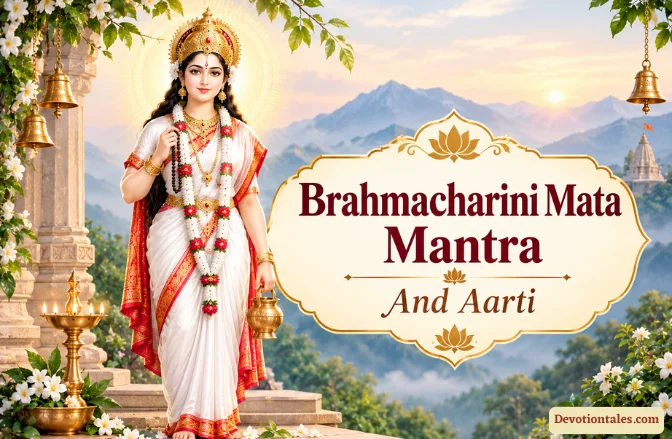
Brahmacharini Mata Mantra is one of the most sacred chants recited during Navratri, particularly on the second day when Goddess Brahmacharini is worshipped. She is the second of the Navadurga forms — a divine embodiment of perseverance, austerity, and unwavering devotion. If you are looking for the complete Brahmacharini Mata Mantra in Hindi, English, Telugu, or Kannada, along with its meaning, aarti, katha, and bhog details, you will find everything you need right here.
Navratri is not just a festival of nine nights — it is a spiritual journey through nine divine forms of Shakti. Each form teaches a different quality of the soul. Brahmacharini Mata, carrying a rosary and a water pot, symbolizes the soul’s readiness to walk the path of self-discipline with complete faith in the divine.
Brahmacharini Mata Background & Significance
The name Brahmacharini comes from two Sanskrit words: Brahma (the supreme reality or sacred knowledge) and Charini (one who walks or moves). Together, the name means “She who walks on the path of supreme knowledge and sacred discipline.”
According to the Puranic tradition, Brahmacharini is the form Goddess Parvati took during her intense penance (tapasya) to win Lord Shiva as her husband. She is said to have observed extreme austerities for thousands of years — surviving on fruits, leaves, and eventually nothing at all. Even the gods and sages were moved by her determination. This story of unwavering dedication forms the spiritual foundation of her worship.
Brahmacharini Mata is depicted wearing simple white clothes, with a calm, radiant face. She holds a japamala (rosary) in her right hand and a kamandalu (water pot) in her left — both symbols of a devotional, disciplined life. She is worshipped on the second day of Navratri to receive blessings of patience, inner strength, wisdom, and liberation from life’s distractions.

Brahmacharini Mata Mantra In Hindi
मुख्य नमस्कार मंत्र
ॐ देवी ब्रह्मचारिण्यै नमः॥
Transliteration (Roman Script):
Om Devi Brahmacharinyai Namah॥
English Meaning:
“I bow in reverence to Goddess Brahmacharini, the divine one who walks the path of sacred discipline.”
Hindi Meaning:
“मैं देवी ब्रह्मचारिणी को प्रणाम करता/करती हूँ, जो तप, संयम और ज्ञान की मार्ग पर चलने वाली परम देवी हैं।”
Brahmacharini Mata Mantra In English (Dhyan Mantra)
ध्यान मंत्र
Sanskrit Text:
दधाना करपद्माभ्यामक्षमालाकमण्डलु।
देवी प्रसीदतु मयि ब्रह्मचारिण्यनुत्तमा॥
Transliteration:
Dadhana Kar Padmabhyam Akshamala Kamandalu।
Devi Prasidatu Mayi Brahmacharinyanuttama॥
Word-by-Word Meaning:
| Sanskrit Word | Meaning |
|---|---|
| दधाना (Dadhana) | holding / bearing |
| करपद्माभ्याम् (Kar Padmabhyam) | in both lotus-like hands |
| अक्षमाला (Akshamala) | rosary / japamala |
| कमण्डलु (Kamandalu) | water pot (carried by ascetics) |
| देवी (Devi) | Goddess |
| प्रसीदतु (Prasidatu) | may she be pleased |
| मयि (Mayi) | upon me |
| ब्रह्मचारिणी (Brahmacharini) | She who walks the path of Brahma (sacred knowledge) |
| अनुत्तमा (Anuttama) | the highest, the most supreme |
English Meaning:
“May the supreme Goddess Brahmacharini, who holds a rosary and a water pot in her lotus hands, be pleased with me and shower her divine grace upon me.”
Hindi Meaning:
“जो देवी अपने कमल के समान हाथों में अक्षमाला और कमण्डलु धारण किए हुए हैं, वे सर्वश्रेष्ठ ब्रह्मचारिणी माता मुझ पर प्रसन्न हों।”
Stuti Mantra – या देवी सर्वभूतेषु
Sanskrit Text:
या देवी सर्वभूतेषु माँ ब्रह्मचारिणी रूपेण संस्थिता।
नमस्तस्यै नमस्तस्यै नमस्तस्यै नमो नमः॥
Transliteration:
Ya Devi Sarvabhuteshu Maa Brahmacharini Rupena Sansthita।
Namastasyai Namastasyai Namastasyai Namo Namah॥
English Meaning:
“Salutations again and again to the Goddess who dwells in all living beings in the form of Brahmacharini. I bow to her, I bow to her, I bow to her repeatedly.”
Hindi Meaning:
“जो देवी सभी प्राणियों में माँ ब्रह्मचारिणी के रूप में विराजमान हैं, उन्हें बारंबार नमस्कार है, नमस्कार है, नमस्कार है।”
Beej Mantra (Associated Navadurga Mantra)
Sanskrit Text:
ॐ ऐं ह्रीं क्लीं चामुण्डायै विच्चे॥
Transliteration:
Om Aim Hreem Kleem Chamundayai Vicche॥
English Meaning:
This is the universal Navadurga seed mantra invoking the energy of Chamunda — the primordial power of the Divine Mother who removes fear and ignorance.
Hindi Meaning:
यह नवदुर्गा का बीज मंत्र है जो देवी की आदि शक्ति का आह्वान करता है।
Note: This mantra is traditionally associated with all nine forms of Durga collectively and is often chanted during Navratri puja as part of the broader Navadurga invocation.
Brahmacharini Mata Mantra in Telugu
Devotees who wish to chant in Telugu can use the following transliteration:
మూల నమస్కార మంత్రం:
ఓం దేవీ బ్రహ్మచారిణ్యై నమః॥
ధ్యాన మంత్రం:
దదానా కరపద్మాభ్యామక్షమాలాకమండలు। దేవీ ప్రసీదతు మయి బ్రహ్మచారిణ్యనుత్తమా॥
Meaning in Telugu: అక్షమాల మరియు కమండలువు తన పద్మ హస్తాలలో ధరించిన సర్వోత్తమ దేవి బ్రహ్మచారిణి నాపై ప్రసన్నురాలు అగుగాక।
Brahmacharini Mata Mantra in Kannada
ಮೂಲ ನಮಸ್ಕಾರ ಮಂತ್ರ:
ಓಂ ದೇವಿ ಬ್ರಹ್ಮಚಾರಿಣ್ಯೈ ನಮಃ॥
ಧ್ಯಾನ ಮಂತ್ರ:
ದಧಾನಾ ಕರಪದ್ಮಾಭ್ಯಾಮಕ್ಷಮಾಲಾಕಮಂಡಲು। ದೇವಿ ಪ್ರಸೀದತು ಮಯಿ ಬ್ರಹ್ಮಚಾರಿಣ್ಯನುತ್ತಮಾ॥
Meaning in Kannada: ಅಕ್ಷಮಾಲೆ ಮತ್ತು ಕಮಂಡಲನ್ನು ತಮ್ಮ ಕಮಲ ಹಸ್ತಗಳಲ್ಲಿ ಧರಿಸಿರುವ ಸರ್ವೋತ್ತಮ ದೇವಿ ಬ್ರಹ್ಮಚಾರಿಣಿ ನನ್ನ ಮೇಲೆ ಕೃಪೆ ತೋರಲಿ।
Brahmacharini Mata Ki Aarti
जय अम्बे ब्रह्माचारिणी माता
जय अम्बे ब्रह्माचारिणी माता। जय चतुरानन प्रिय सुख दाता॥
ब्रह्मा जी के मन भाती हो। ज्ञान सभी को सिखलाती हो॥
ब्रह्मा मंत्र है जाप तुम्हारा। जिसको जपे सकल संसारा॥
जय गायत्री वेद की माता। जो मन निस दिन तुम्हें ध्याता॥
कमी कोई रहने न पाए। कोई भी दुख सहने न पाए॥
उसकी विरति रहे ठिकाने। जो तेरी महिमा को जाने॥
रुद्राक्ष की माला ले कर। जपे जो मंत्र श्रद्धा दे कर॥
आलस छोड़ करे गुणगाना। माँ तुम उसको सुख पहुँचाना॥
ब्रह्माचारिणी तेरो नाम। पूर्ण करो सब मेरे काम॥
भक्त तेरे चरणों का पुजारी। रखना लाज मेरी महतारी॥
English Meaning and Transliteration of Aarti (Stanza by Stanza):
Jay Ambe Brahmacharini Mata | Jay Chaturanan Priya Sukh Data
Glory to Maa Brahmacharini, the divine mother. Glory to the one who is dear to four-faced Lord Brahma and who bestows joy upon all.
Brahma Ji Ke Man Bhati Ho | Gyan Sabhi Ko Sikhlati
Ho You are the one who pleases Lord Brahma’s heart, and you are the great teacher who imparts true knowledge to all beings.
Brahma Mantra Hai Jaap Tumhara | Jisko Jape Sakal Sansara
Your sacred chant is the Brahma Mantra — the mantra that the entire world recites to seek your blessings.
Jay Gayatri Ved Ki Mata | Jo Man Nis Din Tumhe Dhyata
You are Gayatri, the mother of the Vedas. Whoever meditates upon you day and night with a pure heart is never left without your grace.
Kami Koi Rahne Na Paye | Koi Bhi Dukh Sahne Na Paye
May no lack or deficiency remain in the life of your devotee. May no sorrow be allowed to touch those who worship you.
Uski Virati Rahe Thikane | Jo Teri Mahima Ko Jane
One who truly understands your glory remains grounded in detachment and inner peace — free from the pull of worldly distractions.
Rudraksha Ki Mala Le Kar | Jape Jo Mantra Shraddha
De Kar Whoever holds a rudraksha rosary in hand and chants your mantra with sincere devotion — you never leave such a devotee without your blessings.
Alas Chhod Kare Gungana | Maa Tum Usko Sukh Pahunchana
O Mother, the one who casts aside laziness and sings your praises wholeheartedly — please fill their life with happiness and peace.
Brahmacharini Tero Naam | Poorn Karo Sab Mere Kaam
Brahmacharini is your sacred name. I pray to you — please fulfill all my righteous purposes and complete my life’s work.
Bhakt Tere Charno Ka Pujari | Rakhna Laaj Meri Mahtari
Your devotee is a humble worshipper at your feet. O Mother, please protect my honor and never let me down.
Hindi Meaning (सारांश): इस आरती में माँ ब्रह्मचारिणी को ज्ञान, वेद और गायत्री की माता के रूप में पूजा गया है। भक्त प्रार्थना करता है कि माँ उसके जीवन से समस्त कष्ट और कमियाँ दूर करें, उसके मन को वैराग्य और स्थिरता दें, और उसके सभी कार्य पूर्ण करें। रुद्राक्ष माला लेकर श्रद्धा से जपने वाले भक्त की माँ सदा रक्षा करती हैं।
Brahmacharini Mata Ki Katha
Goddess Brahmacharini is the form that Mata Parvati took during her intense penance to win Lord Shiva as her husband. She performed severe austerities for thousands of years without wavering even once. In the early stages of her tapasya, she survived on fruits and leaves. As her penance deepened, she gave up solid food entirely and lived only on water. Finally, she renounced even water and continued her sacred practice in complete self-denial.
The force of her extraordinary penance shook all three worlds. Lord Brahma appeared before her and blessed her, saying — “O Devi, your tapasya will remain immortal for all ages to come. Your heartfelt wish shall certainly be fulfilled.” After testing Mata Parvati’s determination in various ways, Lord Shiva finally accepted her as his consort.
This katha teaches us one timeless truth: when sincere faith and unshakeable resolve come together in the heart, no obstacle in this world can stand in the way.
Brahmacharini Mata Ka Bhog
On the second day of Navratri, it is a long-standing tradition to offer white sugar (chini) or panchamrit as bhog to Maa Brahmacharini.
- Sugar (Chini): White sugar is offered as a symbol of simplicity and sweetness — a reflection of the Goddess herself, who despite years of the harshest austerities, remains gentle, compassionate, and full of grace.
- Panchamrit: This sacred mixture of milk, curd, ghee, honey, and sugar holds a special place in her worship. It represents purity, nourishment, and divine offering.
- Mishri (rock candy) and seasonal fruits are also placed before the Goddess as part of the bhog.
It is traditionally believed that offering white sugar to Maa Brahmacharini brings sweetness into the devotee’s life, along with good health, long life, and lasting happiness.
Brahmacharini Mata Ka Swaroop (Divine Form)
Understanding the divine form of Brahmacharini Mata helps devotees visualize and connect with her during meditation and puja. She is depicted as a radiant, serene goddess dressed in pure white clothing — a color that represents simplicity, purity, and the complete renunciation of worldly desires.
She has two arms, unlike many other goddess forms who carry weapons. This itself is a powerful message: her strength does not come from force but from inner discipline and sacred knowledge.
- Right Hand: Holds a japamala (rosary) — symbolizing continuous divine remembrance, the practice of japa, and the path of devotion.
- Left Hand: Holds a kamandalu (water pot) — a vessel carried by sages and ascetics, representing inner purity, contentment, and a life free from excess.
- Bare feet walking forward: She is often shown walking, not seated on a throne — reflecting her active spiritual journey and the courage to keep moving on the path of tapasya.
- Calm, luminous face: Despite centuries of penance, her expression is one of complete peace — a reminder that true austerity leads not to suffering but to inner radiance.
Meditating on this form while chanting the Dhyan Mantra helps devotees absorb the qualities she embodies: patience, perseverance, and unshakeable faith.
Navratri Day 2 Color – Brahmacharini Mata Ka Rang
The auspicious color for the second day of Navratri is Green (हरा रंग).
Green symbolizes growth, fertility, new beginnings, and the vitality of nature — all qualities that align with Brahmacharini Mata’s energy of renewal through discipline. Devotees traditionally wear green clothing on this day as an act of devotion and to align themselves with the Goddess’s spiritual frequency.
Tip for Devotees: Wearing green on Navratri Day 2 and offering green vegetables or green-colored fruits as part of the bhog is considered auspicious in many regional traditions.
Types of Mantras – What to Chant and When
Many devotees are unsure about which mantra to use at which point in their puja. Here is a simple guide:
| Mantra Type | Sanskrit Text | Best Used For |
|---|---|---|
| Namaskar Mantra | ॐ देवी ब्रह्मचारिण्यै नमः | Opening and closing of puja, daily salutation |
| Dhyan Mantra | दधाना करपद्माभ्यामक्षमालाकमण्डलु… | Meditation, visualization of the Goddess’s form |
| Stuti Mantra | या देवी सर्वभूतेषु… | General invocation, offered three times in sequence |
| Beej Mantra | ॐ ऐं ह्रीं क्लीं चामुण्डायै विच्चे | Japa (repetitive chanting), mala practice |
Beginners can start with just the Namaskar Mantra (108 times) and gradually include the Dhyan Mantra for deeper meditation as they grow in their practice.
Navratri Day 2 Puja Vidhi (How to Worship Brahmacharini Mata)
Worshipping Brahmacharini Mata does not require elaborate arrangements. A sincere heart, a clean space, and a few simple offerings are enough.
Step-by-Step Puja Vidhi:
- Cleanse and Prepare: Wake early, preferably before sunrise. Bathe and wear clean clothes — green is the preferred color for this day.
- Set Up the Altar: Place a picture or idol of Brahmacharini Mata on a clean cloth. Light a ghee lamp (diya) and an incense stick in front of her.
- Offer Flowers and Bhog: Place white flowers (jasmine or chameli are traditional), white sugar (chini), and panchamrit before the Goddess.
- Chant the Mantras: Begin with the Namaskar Mantra, followed by the Dhyan Mantra. Then recite the Stuti Mantra three times. Use a rudraksha mala for japa if available.
- Recite the Aarti: Sing or recite Jay Ambe Brahmacharini Mata with a lighted diya, moving it in a circular motion before the Goddess’s image.
- Offer Prayers and Conclude: Sit quietly for a few moments after the aarti. Offer your personal prayer in silence. Distribute the prasad (chini or mishri) to family members.
Brahmacharini Mata and the Svadhishthana Chakra
In the tradition of Shakti sadhana, each of the nine Navadurga forms is associated with one of the body’s energy centers (chakras). Brahmacharini Mata is linked to the Svadhishthana Chakra — the second chakra, located near the sacral region of the body.
This chakra governs creativity, emotional balance, desire, and the ability to enjoy life while maintaining inner discipline. When this chakra is in balance, a person experiences vitality, focus, and the ability to pursue long-term goals without being pulled off course by momentary impulses.
Chanting the Brahmacharini Mata Mantra on the second day of Navratri is believed by devotees to support the harmonizing of this chakra — helping them move from scattered energy toward sustained, purposeful action.
This is understood as a traditional spiritual belief and part of the Shakta devotional system, rather than a medical or scientific claim.
Spiritual Significance of Brahmacharini Mata Mantra
The Brahmacharini Mata Mantra is not simply a set of words to be repeated mechanically. Each syllable carries an intention — the intention to align one’s inner self with the quality of tapas, or sacred discipline.
In Hindu philosophy, tapas is understood as a purifying fire. Just as gold is tested and refined through heat, the human soul grows through sustained effort, patience, and focused devotion. Brahmacharini Mata embodies this principle perfectly. Her two symbols — the japamala and the kamandalu — represent two essential pillars of spiritual life: continuous remembrance of the divine (japa) and inner purity (the clean, still water of the kamandalu).
Chanting her mantra on the second day of Navratri is believed to activate the svadhishthana chakra (the sacral energy center) and help devotees develop willpower, resist distractions, and pursue their goals with steady determination.
When and How to Recite Brahmacharini Mata Mantra
Best Time: The mantra is traditionally recited during the second day of Navratri, ideally in the brahma muhurta (the pre-dawn hours between 4:00 AM and 6:00 AM) or during the morning puja.
How to Recite:
- Cleanse yourself and sit in a comfortable, quiet place.
- Light a ghee lamp and a stick of incense.
- Place a picture or idol of Brahmacharini Mata before you.
- Begin with the Namaskar Mantra: Om Devi Brahmacharinyai Namah.
- Follow with the Dhyan Mantra and Stuti Mantra.
- Conclude with the aarti.
- Offer white sugar (chini) or panchamrit as prasad.
Repeating the main mantra 108 times using a rosary (mala) is a commonly followed devotional practice, though the sincerity of your prayer matters far more than any specific count.
Traditional Spiritual Benefits
Those who worship Brahmacharini Mata with devotion and chant her mantra regularly are believed to receive:
- Strength of willpower — the ability to persist through difficulties without losing hope.
- Clarity of mind — freedom from restlessness, confusion, and distraction.
- Academic and intellectual growth — she is associated with knowledge, wisdom, and sacred learning.
- Spiritual progress — her blessings help sincere seekers move forward on their inner path.
- Peaceful relationships — a calm, disciplined mind naturally leads to harmonious relationships.
These are traditional beliefs held by devotees across generations. The true gift of any mantra is found in the transformation that sincere practice brings to one’s mind and heart.
Continue Your Navratri Journey
Brahmacharini Mata is the second of the nine divine forms of Shakti. If you have just begun your Navratri observance, you may also want to read our complete guide on [Shailputri Mata Mantra – Navratri Day 1] to start your nine-day journey from the very first form of the Goddess.
Conclusion
Brahmacharini Mata Mantra is a spiritual anchor for anyone walking a path of discipline, patience, and genuine devotion. Her story reminds us that the divine does not demand perfection from us — it asks only for sincere effort and an unwavering heart. Whether you chant the Brahmacharini Mata Mantra in Hindi, English, Telugu, or Kannada, the essence remains the same: a deep surrender to the principle of sacred perseverance.
On this second night of Navratri, offer her a simple handful of sugar, light a quiet lamp, and let her mantra settle into your heart. That stillness — that quiet discipline — is her greatest gift.
May Maa Brahmacharini bless you with inner strength, wisdom, and peace. — Devotion Tales
🔔 For devotion and peace, also explore these mantras & shlokas:
- Shiv Dhyan Mantra
- Aaj Ka Sankalp Mantra
- Shree Swami Samarth Tarak Mantra
- Karagre Vasate Lakshmi Mantra
- Shri Kamal Netra Stotra
- Shatru Nashak Mantra
- Maa Parvati Panchak Stotra
- Sai Kasht Nivaran Mantra
- Gupt Navratri 2026
- Baglamukhi Mantra
Frequently Asked Questions (FAQs)
Q1. What is the main Brahmacharini Mata Mantra?
The primary mantra is Om Devi Brahmacharinyai Namah. The Dhyan Mantra begins with Dadhana Kar Padmabhyam Akshamala Kamandalu.
Q2. On which day of Navratri is Brahmacharini Mata worshipped?
She is worshipped on the second day of Navratri.
Q3. What is the bhog (offering) for Brahmacharini Mata?
White sugar (chini) and panchamrit are her most traditional offerings. Mishri and seasonal fruits are also offered.
Q4. What is the main lesson of Brahmacharini Mata Ki Katha?
That sincere faith combined with unwavering determination can fulfill any heartfelt wish.
Q5. What color is worn on Navratri Day 2?
Green is the auspicious color for the second day of Navratri, associated with Brahmacharini Mata.
Q6. Which chakra is associated with Brahmacharini Mata?
She is linked to the Svadhishthana Chakra (sacral chakra), governing creativity, emotional balance, and focused willpower.
Q7. How many times should the mantra be chanted?
Chanting 108 times with a mala is a common devotional practice, but sincerity and focus matter more than any fixed count.
Q8. Where can I find the Brahmacharini Mata Mantra in Telugu and Kannada?
Both the Telugu and Kannada versions of the mantra are provided in their respective sections above in this article.
