
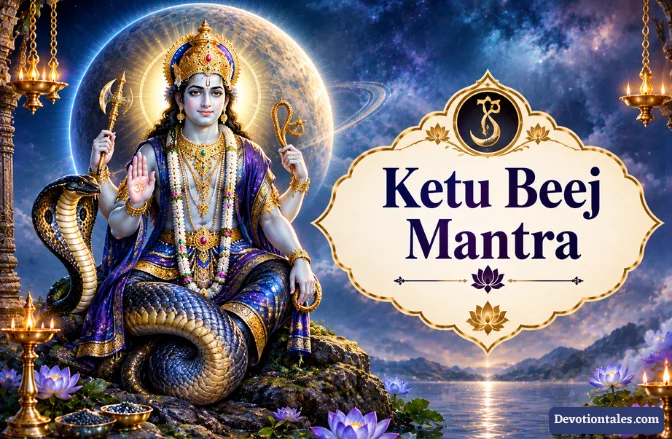
Ketu Beej Mantra is one of the most spiritually potent seed mantras in the Vedic Navagraha tradition. Dedicated to Ketu — the shadow planet of the south lunar node — this mantra carries the compressed vibrational essence of Ketu’s energy: detachment, karmic completion, occult wisdom, and the deep pull toward spiritual liberation.
Unlike most other Navagraha mantras that are sought for material blessings, the Ketu Beej Mantra speaks to a different hunger — the soul’s quiet need to understand what it must release, what remains unfinished from lives gone by, and what genuine inner freedom feels like. Those going through Ketu Mahadasha, Ketu Antardasha, or anyone experiencing the confusion of an afflicted Ketu in their birth chart often turn to this mantra as a reliable Vedic remedy.
But its value extends beyond astrological remedy. Meditators, spiritual seekers, astrologers, healers, and tantric practitioners have chanted this mantra across centuries — not to acquire something, but to let go of what no longer serves the soul’s authentic path.
About Ketu – Background, History & Significance
Who Is Ketu?
In Hindu mythology, Ketu is the headless body of the demon Svarbhanu. During the great churning of the cosmic ocean (Samudra Manthan), the gods and demons were dividing the nectar of immortality (amrita). Svarbhanu disguised himself among the gods and drank the amrita. Lord Vishnu, alerted by the Sun and the Moon, swiftly severed his head with the Sudarshana Chakra. However, since the amrita had already touched his throat, the demon became immortal — his severed head became Rahu and his headless body became Ketu.
This mythological origin is deeply symbolic. Ketu has no head — it does not think, plan, or desire in the way a conscious mind does. It operates entirely from the momentum of past experience, from the weight of karma already lived. In Vedic astrology, this makes Ketu the planet that knows what has already been learned and now asks: Is it time to let this go?
Ketu is classified as a chaya graha (shadow planet) and holds the position of the south lunar node. It moves in retrograde motion and always sits exactly 180 degrees opposite to Rahu. Together, they form the soul’s karmic axis in the birth chart — Rahu pointing toward what the soul must yet experience, and Ketu pointing toward what it has already lived through and must now transcend.
What Does Ketu Govern?
In Vedic astrology and Puranic literature, Ketu is the lord of the following domains:
- Moksha (spiritual liberation) — the ultimate freedom from the cycle of birth and death
- Vairagya (detachment) — the genuine release of attachment to outcomes and identities
- Trikaal Gyan — knowledge of past, present, and future through inner perception
- Tantra and occult sciences — the hidden knowledge of subtle energy and unseen forces
- Psychic faculties — clairvoyance, intuition, and perception beyond ordinary senses
- Past-life karma — the residue of previous incarnations that shapes present circumstances
- Sudden and unexpected events — both losses and unexpected spiritual insights
The three Nakshatras ruled by Ketu are Ashwini, Magha, and Mula — each associated with beginnings, ancestral wisdom, and the rootedness of the soul’s deepest journey.
When Ketu is well-placed and expressed at its highest in the birth chart, the native carries an unmistakable quality of spiritual depth, quiet mastery, and hard-won wisdom. When Ketu is afflicted or poorly positioned, it can bring sudden losses, isolation, mysterious illnesses, and the particular suffering of a soul that has not yet found the courage to release what it is time to let go of.
Ketu Beej Mantra – Complete Sanskrit Text
Mantra in Devanagari
ॐ स्रां स्रीं स्रौं सः केतवे नमः॥
Ketu Beej Mantra in English (Transliteration)
Om Sraam Sreem Sraum Sah Ketave Namah
This is the primary Beej (seed) mantra for Lord Ketu. It is also referred to as the Ketu Graha Beej Mantra and the Ketu Moola Mantra in various Vedic traditions.
Ketu Beej Mantra – Word-by-Word Meaning
| Sanskrit Word | Hindi Meaning | English Meaning |
|---|---|---|
| ॐ (Om) | ब्रह्मांड की आदिध्वनि | The primordial cosmic sound; universal consciousness |
| स्रां (Sraam) | केतु की मूल बीज-ऊर्जा | Primary seed sound activating Ketu’s karmic energy |
| स्रीं (Sreem) | आंतरिक पूर्णता और अभिव्यक्ति की ध्वनि | Sound of inner abundance and authentic expression |
| स्रौं (Sraum) | आत्मिक मुक्ति और अभय की ऊर्जा | Energy of spiritual liberation and fearlessness |
| सः (Sah) | ‘उसके साथ’ — दिव्य सत्ता की पहचान | ‘Together with’ — affirming Ketu’s divine essence |
| केतवे (Ketave) | केतु को (संबोधन रूप) | ‘To Ketu’ — dative form, addressing Lord Ketu directly |
| नमः (Namah) | मैं नमन करता/करती हूँ — समर्पण | I bow with reverence and complete surrender |
Ketu Beej Mantra – Full Meaning
Meaning in Hindi
“हे केतु देव — वैराग्य, अतींद्रिय ज्ञान और कर्म-मुक्ति के स्वामी — मैं ॐ की आदिध्वनि के साथ आपकी बीज-शक्तियों का आह्वान करता/करती हूँ। आपके समक्ष यह समर्पण स्वीकार करें और मुझे आत्मिक स्पष्टता, कर्म-शुद्धि तथा सच्ची मुक्ति की दिशा में मार्गदर्शन दें।”
Meaning in English
“Om. I bow to Lord Ketu — the sovereign of detachment, past-life karma, and spiritual liberation — invoking his sacred seed energies of Sraam, Sreem, and Sraum. Together with his divine essence, I offer this reverent surrender and seek his guidance toward inner clarity, karmic completion, and genuine freedom from illusion.”
Understanding the Three Seed Syllables
The three Beej sounds in this mantra are not arbitrary. Each carries a specific vibrational quality that builds upon the last:
Sraam (स्रां) is the first awakening — the moment the soul recognizes that something from the past is asking to be acknowledged. It activates Ketu’s deep karmic memory and begins the process of surfacing what has been hidden.
Sreem (स्रीं) is the middle passage — the recognition that true inner abundance arises not from accumulation but from authentic completion. It holds the paradox at Ketu’s heart: that releasing what we cling to is often the very act that opens genuine fullness.
Sraum (स्रौं) is the arrival at fearlessness — the liberated state that Ketu at its highest offers. It carries the energy of the soul that has faced the deepest truths about its journey and found, on the other side of that facing, a freedom that nothing external can take away.
Together, these three sounds create a complete inner movement: recognition → completion → liberation.
Ketu Beej Mantra in Hindi (हिंदी में)
मंत्र
ॐ स्रां स्रीं स्रौं सः केतवे नमः॥
हिंदी अर्थ
“ॐ। मैं भगवान केतु को नमन करता/करती हूँ — स्रां, स्रीं, स्रौं की दिव्य बीज-शक्तियों के साथ। हे केतु देव, मेरे कर्म-संस्कारों को शुद्ध करें, मेरी आत्मा को सच्चे ज्ञान की ओर ले चलें और जो छोड़ना आवश्यक है, उसे छोड़ने की शक्ति दें।
Other Ketu Mantras – Variants & Their Meanings
The Vedic tradition preserves several forms of Ketu’s mantra, each serving a distinct purpose:
1. Ketu Short Mantra (Laghu Mantra)
Sanskrit:
ॐ कें केतवे नमः
Transliteration:
Om Kem Ketave Namah
English Meaning:
“Om. I bow to Lord Ketu.”
Hindi Meaning:
“ॐ। भगवान केतु को मेरा प्रणाम।”
Used for daily quick practice or when time is limited.
2. Ketu Vedic Stotra (Puranic Verse)
Sanskrit:
पलाशपुष्पसंकाशं तारकाग्रहमस्तकम्।
रौद्रं रौद्रात्मकं घोरं तं केतुं प्रणमाम्यहम्॥
Transliteration:
Palaasha Pushpa Sankaasham Taarakagraha Masthakam।
Rowdhram Rowdhaatmakam Ghoram Tam Ketum Pranamamyaham॥
English Meaning: “I bow to Ketu, who blazes like the flame-red Palash blossom, who presides at the head of the constellation-planets, who is fearsome and fierce in form — to that Ketu I offer my salutations.”
Hindi Meaning: “जो पलाश के फूल के समान तेजस्वी हैं, जो तारकाग्रहों के मस्तक पर विराजमान हैं, जो रौद्र और घोर स्वरूप वाले हैं — उन भगवान केतु को मैं प्रणाम करता/करती हूँ।”
3. Ketu Gayatri Mantra
Sanskrit:
ॐ चित्रवर्णाय विद्महे सर्परूपाय धीमहि।
तन्नो केतुः प्रचोदयात्॥
Transliteration:
Om Chitravarnaaya Vidmahe Sarparuupaaya Dhimahi।
Tanno Ketuh Prachodayaat॥
English Meaning: “Om. We meditate upon the multi-hued one, we contemplate upon the one who wears the form of the serpent. May Lord Ketu illuminate and inspire our intellect.”
Hindi Meaning: “ॐ। हम विचित्र वर्णों वाले केतु का ध्यान करते हैं, जो सर्प-रूप धारण करते हैं। हमारी बुद्धि को वे प्रेरित और प्रकाशित करें।”
Ketu Beej Mantra Jaap – Complete Method
Auspicious Day (Shubh Din)
Tuesday (Mangalvaar) and Saturday (Shanivaar) are the most traditionally recommended days for Ketu mantra practice. Some practitioners also include Sunday. For stronger results, begin the practice on a Tuesday in Shukla Paksha (the waxing fortnight of the lunar month).
Particularly potent days include:
- When the Moon transits Ashwini, Magha, or Mula Nakshatra (Ketu’s own Nakshatras)
- Solar or lunar eclipse days, which carry concentrated Rahu-Ketu energy
- During Ketu Mahadasha or Antardasha periods — daily practice is recommended throughout
Best Time (Shubh Samay)
The liminal hours — before sunrise (Brahma Muhurta) and after sunset (twilight) — are considered most aligned with Ketu’s nature as a shadow planet that exists at the threshold between the visible and the invisible. Deep nighttime hours when the external world is quiet are also considered highly suitable.
Direction (Disha)
Sit facing Northeast. Some Jyotish lineages recommend Southwest for Ketu practice, as the southwest direction is associated with completion and release in certain Vedic spatial traditions. Follow the guidance of your specific lineage or astrologer.
Preparation
- Bathe before practice
- Wear clean clothing; grey, ash, or dark smoky tones are traditionally associated with Ketu
- Sit on a clean mat (asana) — wool or kusha grass is traditional
- Perform a brief invocation of your Guru and Ishta Devata before beginning
The Mala
Use a Rudraksha mala (108 beads). A Kusha grass mala is also considered appropriate for Ketu sadhana, as Kusha is associated with purification and ancestral merit — both within Ketu’s domain.
Chanting Count
| Purpose | Count |
|---|---|
| Daily regular practice | 108 times (one mala) |
| Purashcharan / Sadhana | 17,000 – 18,000 repetitions within 40 days |
| Ketu Mahadasha support | 108 times daily throughout the 7-year period |
| Protection practice | 108 times daily for minimum 21 days |
Visualization During Jaap
Close your eyes. Direct your attention to the space between your eyebrows (the Ajna Chakra). Visualize a vivid inner light at this point — not an external flame, but the luminous quality of consciousness itself. As you chant, hold the feeling that Ketu’s energy of clarity, release, and deep knowing is gently entering your awareness and quietly dissolving whatever has been held too long.
Benefits of Ketu Beej Mantra
Ketu Beej Mantra Fast – Chanting for Specific Purposes
For those undertaking a specific Ketu sadhana or vow (vrat), here are the traditional approaches based on purpose:
For Ketu Dosha Shanti: Begin on a Tuesday in Shukla Paksha. Chant 108 times daily. Maintain for 40 consecutive days without interruption.
For Ketu Mahadasha Support: Chant one full mala (108 repetitions) daily throughout the Mahadasha period. The consistency across the full period is more valuable than a brief intensive.
For Spiritual Development and Meditation Deepening: Practice during Brahma Muhurta (approximately 4–5 AM). One to three malas daily. The effect on meditation depth is often noticed within the first two weeks.
For Protection: 108 repetitions daily for a minimum of 21 continuous days.
Who Should Chant the Ketu Beej Mantra?
This mantra is open to all sincere seekers. It is particularly recommended for:
- Those currently running Ketu Mahadasha or Antardasha
- Those with Ketu placed in the 1st, 2nd, 5th, or 7th house, or in difficult conjunction with other planets
- Those experiencing sudden and unexplained losses, isolation, or mysterious health issues
- Astrologers, healers, tantriks, and spiritual teachers seeking to deepen their practice and inner perception
- Those feeling spiritually lost, disconnected from guidance, or uncertain about their authentic direction
- Anyone who recognizes that their most important growth in this lifetime is inward rather than outward
- Those drawn to meditation, yoga, renunciation, or the deeper philosophical traditions of Hinduism
There is no gender restriction or caste restriction for this mantra. Anyone who approaches it with sincerity and genuine devotion may practice it.
Ketu and Rahu – The Karmic Axis
Rahu and Ketu are always exactly 180 degrees apart in the birth chart. They represent the two poles of the soul’s karmic journey in this incarnation — Rahu the direction of unfulfilled desire and new experience calling the soul forward, Ketu the direction of accumulated wisdom and past mastery asking to be completed and released.
Because of this deep complementarity, many advanced practitioners who work with one shadow planet’s mantra also incorporate the other’s. Chanting both the Rahu Beej Mantra and the Ketu Beej Mantra creates a comprehensive engagement with the soul’s entire karmic axis — conscious relationship with both the new experiences Rahu beckons toward and the old completions Ketu requires.
Conclusion
The Ketu Beej Mantra does not ask the universe for more. It asks the soul for something far rarer and far more liberating — the courage to recognize what has already been lived, what has already been learned, and what is now ready to be released with grace.
In a world that consistently equates spiritual practice with acquiring — more blessings, more protection, more success — this mantra stands quietly apart. It offers something the acquiring mind cannot grasp until it stills itself long enough to recognize it: the deep peace of a soul that finally, consciously, knows which direction home actually is.
Sit before sunrise. Close your eyes. Let the breath settle into quietness. Visualize the soft inner light at the center of your forehead. And let the syllables form with full sincerity — Om Sraam Sreem Sraum Sah Ketave Namah — trusting that the headless planet who carries so much of the soul’s unfinished story is ready, through this ancient practice, to become not a source of confusion but a profound and precise teacher.
Devotion Tales brings you the authentic meaning and practice of Hindu devotional mantras — because the right understanding transforms a recitation into a genuine conversation with the divine.
🔔 Also explore these mantras & shlokas:
- Shiv Dhyan Mantra
- Aaj Ka Sankalp Mantra
- Shree Swami Samarth Tarak Mantra
- Karagre Vasate Lakshmi Mantra
- Shri Kamal Netra Stotra
- Shatru Nashak Mantra
- Maa Parvati Panchak Stotra
- Sai Kasht Nivaran Mantra
- Gupt Navratri 2026
- Baglamukhi Mantra
- Chandra Beej Mantra
Frequently Asked Questions (FAQs)
Q1. What is the Ketu Beej Mantra?
It is the Vedic seed mantra for Lord Ketu: Om Sraam Sreem Sraum Sah Ketave Namah. It is chanted to pacify Ketu’s challenging influences, support spiritual growth, and deepen karmic awareness.
Q2. What is the Ketu Beej Mantra in English?
The English transliteration is: Om Sraam Sreem Sraum Sah Ketave Namah. The meaning is: “I bow to Lord Ketu, invoking his seed energies for spiritual liberation and inner clarity.”
Q3. What are the Benefits of Ketu Beej Mantra?
Relief from Ketu dosha, spiritual growth, deepening of intuition, karmic healing, protection from negative energies, mental peace, and support during Ketu Mahadasha are the principal traditional benefits.
Q4. How many times should I chant the Ketu Beej Mantra (Jaap)?
108 times daily (one mala) is the standard. For a complete sadhana, 17,000 to 18,000 repetitions over 40 days is traditionally prescribed.
Q5. When is the best time for Ketu Beej Mantra Jaap?
Tuesday or Saturday, during twilight hours (before sunrise or after sunset). Days when the Moon is in Ashwini, Magha, or Mula Nakshatra are especially auspicious.
Q6. What is the Ketu Beej Mantra Meaning in Hindi?
“हे केतु देव, स्रां स्रीं स्रौं की बीज-शक्तियों सहित मैं आपको नमन करता/करती हूँ — आत्मिक मुक्ति, कर्म-शुद्धि और सच्चे ज्ञान की प्रार्थना के साथ।”
